New Cabinet Entries
05/22/2026Title
Tiemann Surgical Instrument Kit in Wooden Case
Author
Manufactured by Tiemann & Co., New York
Image
Description
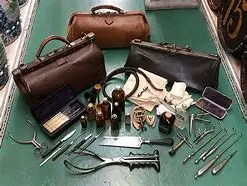
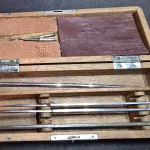
This late 19th to early 20th century surgical instrument kit was manufactured by Tiemann & Co., one of the most respected American makers of surgical and medical instruments during the Victorian and early modern medical era. The compact wooden carrying case contains several steel surgical knives or scalpels of varying blade profiles, interchangeable threaded instrument tips, and long probe-like instruments arranged in fitted compartments.
The interior retains remnants of its original felt or velvet lining, and the exterior bears a handwritten ownership inscription reading “F.E. Tapman” (or similar), likely identifying the physician or medical student who once owned the kit. The knives remain remarkably sharp despite their age, reflecting the quality of surgical steel and the expectation that instruments of the era would be repeatedly sharpened, sterilized, and reused throughout a physician’s career.
The exact specialty use of the kit is uncertain, but it was likely intended for minor surgery, dissection, ENT work, ophthalmic procedures, or general medical practice. The varying blade shapes and interchangeable components suggest a practical field or office surgical set rather than a decorative display piece.
Condition
Complete wooden case with moderate age wear, scratches, and handling marks consistent with age and medical use. Interior lining shows wear and deterioration. Instruments retain original patina and oxidation with scattered spotting and surface discoloration. Several blades remain extremely sharp. The set appears partially incomplete but retains strong historical integrity and display appeal.
Gallery
Historical context
George Tiemann & Co. was founded in New York in the 19th century and became one of the premier American manufacturers of surgical, dental, orthopedic, and military medical instruments. Tiemann instruments were widely used by physicians and surgeons during a period when medicine was transitioning from crude pre-antiseptic surgery into more modern operative practice.
Before disposable instruments became standard, surgical tools were valuable professional investments that were maintained, sharpened, and reused for decades. Compact surgical kits like this were often carried directly to homes, clinics, or hospital wards by physicians making house calls or performing office procedures.
Curious Facts, Ephemera, and Trivia
Surgical instruments from this era were frequently hand-finished and made from high-quality carbon steel capable of taking extremely fine edges.
Razor-sharp scalpels were considered essential because faster, cleaner incisions reduced tissue trauma and patient suffering before modern anesthesia and antibiotics.
Tiemann supplied instruments during the Civil War era and later became one of the dominant American surgical instrument houses.
Many surviving antique surgical kits have been over-polished by collectors. This example retains its original aged appearance and authentic medical character.
Excerpt
“Not every antique medical instrument tells you what it was used for. Some simply sit there quietly and let your imagination do the rest.”
Why it is in the Cabinet
This set represents the reality of historical medicine — practical, reusable, personal, and slightly intimidating. The worn case, surviving sharpness, and evidence of long-term use give the impression of a real working physician’s instrument kit rather than a decorative curiosity. It captures the transition period between Victorian medicine and the beginnings of modern surgery, making it a perfect fit for the Cabinet of Medical Curiosities.
← Back to the Cabinet Directory
Support Dr. Bebout’s Cabinet of Medical Curiosities
If you enjoy the history, the oddities, and the effort, help keep this cabinet open. Every little bit helps preserve and share the strange wonders of medicine’s past.
Buy Me a Ko-fi ☕
Buy Me a Coffee ☕
Tip via PayPal 💵 [...]Read more...
05/21/2026Title
Angina Pectoris
Author
By Harlow Brooks, M.D.
Published 1929 by Harper & Brothers Publishers, New York and London
Image
Description
Angina Pectoris by Harlow Brooks is a compact physician’s monograph published as part of the Harper’s Medical Monographs series in 1929. Written specifically for practicing physicians, the work attempts to synthesize the historical understanding, pathological theories, symptomatology, and treatment approaches surrounding angina pectoris during the late interwar period — just before the explosion of modern cardiology, cardiac catheterization, and evidence-based coronary disease management.
Brooks, a prominent New York physician and professor of clinical medicine, presents angina not merely as a symptom, but as a dramatic and complex syndrome demanding careful clinical observation. The text reflects a fascinating transitional era in medicine: physicians clearly recognized the seriousness and classic presentation of coronary disease, yet still lacked many of the diagnostic tools and therapies that modern clinicians now take for granted.
Particularly interesting are discussions of “toxic angina,” in which excessive tobacco, coffee, and tea consumption were proposed as causes of angina-like syndromes. The monograph also illustrates the enormous uncertainty surrounding the pathophysiology of coronary pain during the 1920s, with Brooks openly acknowledging the abundance of competing theories and the frustrating lack of consistently effective treatment options.
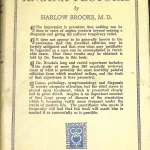
The volume is bound in dark textured cloth with gilt lettering and includes surviving publisher promotional inserts and advertising material for future medical monographs — ephemera rarely retained in heavily used physician reference books.
Condition
Very good antique condition overall. Binding remains solid with clean and highly legible interior pages. Mild edge wear and corner bumping are present, particularly at the spine ends. Gilt spine lettering remains attractive and readable. Includes original publisher insert pages and advertising material, an uncommon survival for a practical physician’s handbook of this period.
Gallery
Historical context
This monograph was published during a major transitional period in cardiovascular medicine. By 1929, physicians clearly understood that angina pectoris was associated with disease of the coronary circulation, yet the precise mechanisms and effective interventions remained controversial and limited. Electrocardiography was still relatively primitive, coronary angiography did not yet exist, and treatments largely focused on rest, vasodilators such as nitroglycerin, lifestyle moderation, and symptom management.
The text repeatedly references William Heberden’s landmark 1768 description of angina pectoris, demonstrating how strongly early twentieth-century cardiologists still relied upon classical bedside observation and descriptive clinical medicine.
Brooks himself represented the archetype of the early twentieth-century academic clinician: physician, professor, consultant, military medical officer, lecturer, and prolific contributor to medical literature. His career bridged nineteenth-century descriptive medicine and the emerging scientific medical era.
Curious Facts, Ephemera, and Trivia
The book was issued as part of Harper’s Medical Monographs, a series designed specifically for busy practicing physicians needing concise but authoritative references.
The surviving yellow publisher insert asking physicians to mail in their address for announcements of future monographs is an unusual survivor and provides a wonderful glimpse into early medical publishing marketing.
Brooks discusses “toxic angina” caused by excessive tobacco, coffee, and tea use — a reminder that stimulant-associated cardiovascular symptoms were recognized long before modern cardiology fully understood coronary artery disease.
One passage humorously acknowledges the overwhelming number of competing theories explaining angina pectoris, essentially admitting that the literature contained more explanations than useful treatments.
The author served as a Colonel in the U.S. Army Medical Reserve and worked as a senior consultant during World War I.
Excerpt
“The writer wishes to offer an apology for still further encumbering the literature of the subject already too rich in explanations and too poor in therapeutic suggestions for the relief of the condition.”
That line could probably still be muttered by exhausted specialists at some modern cardiology conferences after the fourth PowerPoint on inflammatory biomarkers.
Why it is in the Cabinet
This volume captures a remarkable midpoint in the history of cardiology — far enough along that physicians clearly recognized coronary disease as a deadly clinical entity, yet still operating in an era before cardiac catheterization, bypass surgery, coronary stents, troponins, stress imaging, or modern lipid management.
It is also a wonderful example of practical physician literature from the interwar years: compact, direct, experience-driven, and unapologetically clinical. The surviving inserts and clean presentation make it especially appealing as both a historical artifact and display piece within the Cabinet library.
← Back to the Cabinet Directory
Support Dr. Bebout’s Cabinet of Medical Curiosities
If you enjoy the history, the oddities, and the effort, help keep this cabinet open. Every little bit helps preserve and share the strange wonders of medicine’s past.
Buy Me a Ko-fi ☕
Buy Me a Coffee ☕
Tip via PayPal 💵 [...]Read more...
05/10/2026Title
Disorders of Menstruation
Author
Edward W. Jenks, M.D., LL.D.
Image
Description
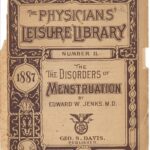
Disorders of Menstruation is an 1888 medical monograph authored by Edward W. Jenks and published in Detroit by George S. Davis as part of the Physicians’ Leisure Library, Second Series. This compact volume was intended as a practical reference for physicians managing gynecologic conditions, with a particular focus on menstrual irregularities including amenorrhea, dysmenorrhea, and menorrhagia.
The text reflects late 19th-century gynecologic practice, blending emerging scientific understanding with therapeutic approaches that now appear aggressive or antiquated. Treatments described include pharmacologic interventions using compounds such as iodine, arsenic, strychnine, and opiates, as well as mechanical and surgical techniques including cervical dilation and uterine instrumentation.
The book is notable not only for its clinical content but also for its pharmaceutical advertisements, including products from Parke, Davis & Co. and Fairchild Bros. & Foster. These advertisements provide valuable insight into the commercial side of medicine during this era, when standardized drug manufacturing was still developing and therapeutic claims were often broad and loosely regulated.
Condition
Digitally preserved copy created from a disbound and scanned original. Pages were individually scanned, reassembled into a PDF, and processed with OCR for full text searchability. Original binding condition not retained due to digitization process.
Gallery
Historical context
By the late 1800s, gynecology was emerging as a defined medical specialty, but much of its practice remained rooted in empirical observation rather than modern evidence-based medicine. Menstrual disorders were often attributed to systemic imbalances, nervous conditions, or uterine pathology, and treatments frequently reflected these assumptions.
This period also represents a transitional phase in pharmacology. Companies such as Parke-Davis were beginning to standardize drug preparations, but regulation was minimal, and many compounds in common use would later be recognized as toxic or ineffective. Works like this illustrate both the progress and the limitations of medicine at the time.
Curious Facts, Ephemera, and Trivia
Part of the Physicians’ Leisure Library, a serialized medical publication designed to provide affordable continuing education for physicians.
Includes pharmaceutical advertisements featuring early branded drug formulations, including “Liquor Sedans” by Parke, Davis & Co.
Reflects a time when substances such as arsenic and strychnine were considered legitimate therapeutic agents.
Demonstrates the overlap between gynecology and “nervous disorders,” a common diagnostic framework in 19th-century medicine.
Excerpt
“In chlorotic and anemic patients, particularly inthe former, other remedies than iron are required,arsenic and strychnia being frequently of great service;” Pg. 6
Why it is in the Cabinet
This work represents a snapshot of gynecology at a pivotal moment in medical history — a period when physicians were actively trying to move beyond tradition but had not yet reached modern scientific standards. It highlights both the ingenuity and the limitations of 19th-century medicine and serves as a reminder of how far clinical practice has evolved.
Digital Access:Download the full scanned PDF from this site or view the preserved archival copy via the Internet Archive: https://archive.org/details/disorders-of-menstruation
← Back to the Cabinet Directory
Support Dr. Bebout’s Cabinet of Medical Curiosities
If you enjoy the history, the oddities, and the effort, help keep this cabinet open. Every little bit helps preserve and share the strange wonders of medicine’s past.
Buy Me a Ko-fi ☕
Buy Me a Coffee ☕
Tip via PayPal 💵 [...]Read more...
05/06/2026Title
Mendenhall’s Malaria Chill and Fever Tonic Advertising Booklet
Author
J. C. Mendenhall Medicine Co., Evansville, Indiana
Image
Description
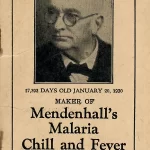
This small advertising booklet promotes Mendenhall’s Malaria Chill and Fever Tonic, a patent medicine produced by the J. C. Mendenhall Medicine Co. of Evansville, Indiana. The front panel features a portrait of J. C. Mendenhall, born January 20, 1855, and notes that he was “27,392 days old January 20, 1930,” dating this promotional piece to about 1930.
The booklet advertises the product as a “tonic and appetizer” for malaria, chills, and fever. Inside, it includes testimonial-style copy from a former Memphis resident in the Canal Zone, a dramatic “This Medicine Saved the Baby” claim, and a physician endorsement from Arkansas. The advertising is classic patent-medicine theater: personal testimony, doctor approval, cure language, child-saving drama, and just enough pseudo-scientific phrasing to make the poison go down easier.
One of the most historically significant details is the reference to two versions of the tonic: a regular version without arsenic and a red-label version containing arsenic. The booklet states that the arsenic version contained Fowler’s solution, an arsenic preparation historically used in medicine. Smithsonian holdings document Mendenhall’s Malaria Chill and Fever Tonic as a product of J. C. Mendenhall Medicine Co. and list its claimed use for malaria, chills, and fever. Fowler’s solution was a potassium arsenite preparation used historically as a tonic and in treatments for conditions including malaria and syphilis, before arsenic’s toxicity and long-term harms became impossible to politely ignore.
Condition
Original paper advertising booklet with visible age toning, fold wear, small edge creases, minor staining, and light surface soiling. Interior pages remain legible. Binding fold shows small staple or puncture marks. Overall condition is good for fragile pharmaceutical advertising ephemera of this period.
Gallery
Historical context
Malaria, chills, and intermittent fever were major medical concerns in the American South, river valleys, and tropical regions. Before modern antimalarial therapy and mosquito-control programs became widespread, “chill tonics” were heavily marketed to the public. Some contained quinine. Others leaned into tonics, bitters, alcohol, laxatives, or arsenic compounds.
Mendenhall’s booklet sits squarely in that transitional world between old patent-medicine salesmanship and early 20th-century drug regulation. The company was still using testimonial advertising, cure claims, and dramatic personal stories, but the copy also tries to sound measured by specifying arsenic content and giving dose-related language. That makes it especially useful as a Cabinet item: it is not just “old medicine advertising.” It is an artifact showing how dangerous ingredients were normalized through respectable-looking medical language.
Curious Facts, Ephemera, and Trivia
The booklet makes the oddly specific claim that J. C. Mendenhall was 27,392 days old on January 20, 1930. That is a weird little advertising flourish, and frankly, I respect the commitment to unnecessary math.
The red-label version reportedly contained five minims of Fowler’s solution of arsenic per fluid ounce of the regular tonic. Fowler’s solution was historically a potassium arsenite preparation. In plain English: this was not “herbal wellness nonsense.” This was arsenic in a bottle wearing a necktie.
The advertising also claims the product was useful when quinine was “contraindicated,” giving it a niche as an alternative malaria remedy. Whether that reflected thoughtful therapeutics or marketing opportunism is exactly the kind of thing that makes patent medicine collecting such a fun little haunted house.
Excerpt
“This medicine saved the baby.”
“We make Mendenhall’s Malaria Chill and Fever Tonic with and without arsenic.”
“It contains five minims Fowler’s solution of Arsenic to each fluid ounce of our Chill Tonic Regular.”
Why it is in the Cabinet
This booklet belongs in the Cabinet because it captures several major themes in early American pharmaceutical history: malaria fear, patent-medicine advertising, physician testimonials, arsenic as therapy, and the uneasy overlap between legitimate medicine and commercial cure-all marketing.
It is especially strong because the item openly discusses the arsenic-containing version rather than hiding behind vague “tonic” language. That makes it a compact but powerful teaching piece. It is small, paper, and easy to overlook — but historically it punches above its weight.
← Back to the Cabinet Directory
Support Dr. Bebout’s Cabinet of Medical Curiosities
If you enjoy the history, the oddities, and the effort, help keep this cabinet open. Every little bit helps preserve and share the strange wonders of medicine’s past.
Buy Me a Ko-fi ☕
Buy Me a Coffee ☕
Tip via PayPal 💵 [...]Read more...
04/29/2026Title
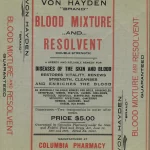
Von Hayden “Brand” Blood Mixture and Resolvent (Double Strength)
Author
Columbia Pharmacy, Spokane, Washington
Image
Description
This printed advertising sheet promotes Von Hayden’s “Blood Mixture and Resolvent”, a late 19th to early 20th century patent medicine marketed as a “double strength” remedy for a wide range of systemic and dermatologic conditions. The layout is bold and highly structured, with red and black typography emphasizing its primary claims—purifying, enriching, and restoring the blood.
The product is described as a “speedy and reliable remedy” for diseases of the skin and blood, with an almost comically broad list of indications including boils, carbuncles, erysipelas, tumors, ulcers, ringworm, scrofula, syphilitic affections, and even “cancerous humors.” The language reflects the lingering 19th-century humoral theory mindset, where disease was attributed to impurities in the blood.
Dosing instructions are straightforward—two teaspoonfuls in water after meals—and the listed price of $5.00 suggests this was positioned as a premium therapeutic product for its time. The reference to compliance with the Food and Drugs Act of 1906–1907 places this piece squarely in the transitional period when manufacturers began adapting their claims to new federal regulations without actually toning them down much.
Condition
Paper ephemera with expected age-related toning and minor wear; typography remains strong and fully legible with no major loss of content.
Gallery
Historical context
This advertisement represents the tail end of the golden age of patent medicines, just after passage of the Pure Food and Drug Act of 1906. During this period, manufacturers were forced to acknowledge regulation but still freely made sweeping therapeutic claims. Products labeled as “blood purifiers” were especially common, reflecting older medical beliefs that systemic illness originated from contaminated or imbalanced blood.
The inclusion of terms like “scrofula” and “humors” shows how deeply pre-modern medical language persisted well into the early 20th century, even as bacteriology and modern pathology were already taking hold in academic medicine.
Curious Facts, Ephemera, and Trivia
The term “resolvent” historically referred to a substance believed to dissolve pathological growths or “resolve” swellings—essentially a catch-all for anything from tumors to infections.
Listing syphilitic affections alongside pimples and ringworm tells you everything you need to know about diagnostic precision at the marketing level.
The $5.00 price tag was substantial at the time—this wasn’t a cheap tonic; it was marketed as serious medicine.
The “Guaranteed under the Food and Drugs Act” line was often more about consumer reassurance than actual scientific validation.
Excerpt
A speedy and reliable remedy for diseases of the skin and blood… restores vitality, renews strength, cleanses and enriches the blood.
Why it is in the Cabinet
This is exactly the kind of piece that tells the story better than any textbook. Not the theory—not the science—but what people were actually being sold. It’s a snapshot of medicine in transition: regulation creeping in, but the wild claims still running the show. This is the marketing side of medicine before evidence-based practice cleaned house.
← Back to the Cabinet Directory
Support Dr. Bebout’s Cabinet of Medical Curiosities
If you enjoy the history, the oddities, and the effort, help keep this cabinet open. Every little bit helps preserve and share the strange wonders of medicine’s past.
Buy Me a Ko-fi ☕
Buy Me a Coffee ☕
Tip via PayPal 💵 [...]Read more...

04/29/2026Title
A Practical Manual of the Diseases of Children (1879)
Author
Edward Ellis, M.D.
Image
Description
This 1879 third edition of A Practical Manual of the Diseases of Children by Edward Ellis represents a late 19th-century attempt to bring structure and practicality to pediatric medicine—at a time when pediatrics was still emerging as a distinct field. Published by William Wood & Company as part of Wood’s Library of Standard Medical Authors, the book was intended as a working physician’s reference rather than a purely academic treatise.
The text combines clinical observation with a detailed formulary, reflecting the era’s reliance on compound preparations and empirical treatment strategies. It covers common pediatric illnesses such as measles, respiratory conditions, neurologic disorders, and developmental abnormalities, alongside therapeutic recommendations that range from the familiar to the now deeply questionable. The inclusion of dosing instructions for children highlights the growing recognition that pediatric patients required distinct medical consideration rather than simply scaled-down adult treatment.
Notably, the book blends careful bedside observation with treatments that include emetics, bromides, arsenic compounds, and external applications such as mustard baths—illustrating the transitional nature of medicine in this period, straddling early scientific reasoning and older therapeutic traditions.
Condition
Original cloth binding with embossed geometric pattern typical of Wood’s Library series. Spine lettering remains clear and legible. Moderate edge wear and corner bumping consistent with age. Interior pages are clean and well-preserved with minimal toning. Binding appears solid. Includes original ribbon marker.
Gallery
Historical context
By the late 1800s, pediatric medicine was beginning to separate from general practice, though it was still heavily influenced by adult medicine and observational diagnosis. Ellis’s work reflects this shift—placing emphasis on clinical examination, symptom progression, and structured treatment.
This period predates antibiotics, modern vaccines (outside early smallpox work), and advanced diagnostics. Physicians relied heavily on pattern recognition, physical exam findings, and symptomatic management, often guided by tradition and evolving clinical experience. The formulary sections demonstrate how treatment was still deeply rooted in pharmacologic experimentation, with substances like ipecac, bromides, and arsenic used with surprising confidence.
Curious Facts, Ephemera, and Trivia
The book includes precise pediatric pulse ranges, showing early attempts at age-based vital sign norms.
Measles is described in detail, including progression and rash morphology—remarkably accurate clinically, even by modern standards.
Treatments include mustard baths, emetics, and arsenic-based preparations, highlighting the therapeutic uncertainty of the era.
The formulary reflects a time when physicians often compounded medications themselves or directed pharmacists to do so.
The term “idiocy” is used diagnostically, illustrating historical approaches to developmental and neurologic disorders.
Apomorphia (apomorphine) is referenced as a “recently discovered” emetic—cutting-edge pharmacology for 1879.
Excerpt
“An idiot is one who, in consequence of some cerebral abnormality… becomes irrecoverably deficient in mental power…”
and
“Mustard is a capital emetic, always at hand and useful in emergencies… rapidly produces vomiting without depression.”
Why it is in the Cabinet
This is exactly the kind of book that shows medicine mid-evolution—not primitive, not modern, but caught in between. You get sharp clinical observation sitting right next to treatments that make you raise an eyebrow. It’s a working physician’s book, not a showpiece, and that’s what makes it valuable. It reflects how doctors actually practiced—what they believed, what they tried, and how they reasoned through disease without the tools we take for granted today.
Read the Digital Version
A complete digital copy of A Practical Manual of the Diseases of Children (1879) is available for viewing.
This edition has been preserved and made accessible to allow direct exploration of late 19th-century pediatric practice, including its clinical observations and period treatments.
👉 Read the full book here:A Practical Manual of the Diseases of Children (1879)
← Back to the Cabinet Directory
Support Dr. Bebout’s Cabinet of Medical Curiosities
If you enjoy the history, the oddities, and the effort, help keep this cabinet open. Every little bit helps preserve and share the strange wonders of medicine’s past.
Buy Me a Ko-fi ☕
Buy Me a Coffee ☕
Tip via PayPal 💵 [...]Read more...