New Cabinet Entries
06/02/2026Title
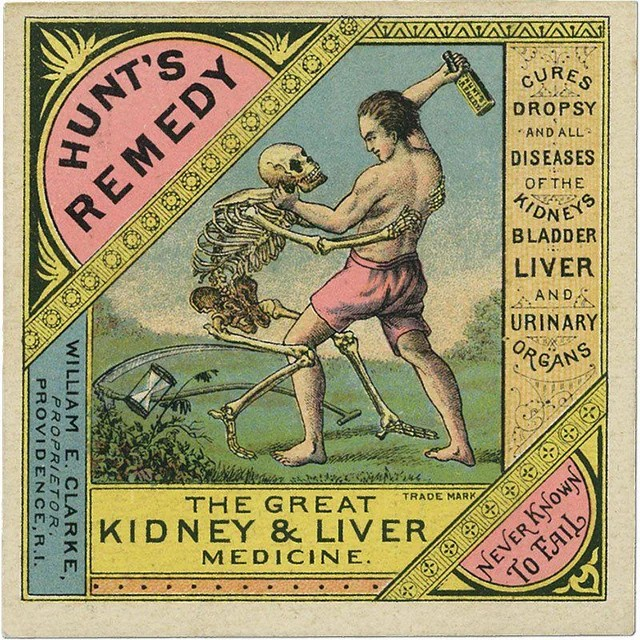
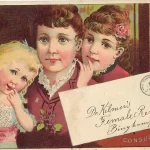
Dr. Kilmer’s Female Remedy Advertising Trade Card
Author
Dr. Kilmer & Co., Binghamton, New York
Image
Description
Late 19th-century chromolithographic advertising trade card promoting Dr. Kilmer’s Female Remedy, a proprietary patent medicine marketed toward women’s health complaints. The colorful front depicts a mother with two children beside an addressed envelope advertising “Dr. Kilmer’s Female Remedy, Binghamton, N.Y.” and the promise of “Consultation by Mail Free.”
The reverse is a dense wall of therapeutic claims typical of the era’s aggressive patent-medicine advertising. The remedy is promoted as a “great blessing to women,” claiming benefit for an astonishing range of complaints including headaches, stomach trouble, back pain, bloating, “bearing down,” “uterine catarrh,” menstrual disorders, “ovarian dropsy,” nervous exhaustion, suspicious growths, hemorrhage, and even conditions suggestive of cancer.
Produced during the height of America’s patent-medicine boom, this card reflects a period when medical advertising relied heavily on emotional appeals to motherhood, femininity, chronic suffering, modesty, and fear of hidden disease. The offer of free consultation by mail also illustrates the expanding mail-order medical marketplace of the late nineteenth century.
Condition
Very good antique condition with expected age toning, minor edge and corner wear, and light surface handling wear consistent with late-19th-century paper ephemera. Graphics remain attractive and text is fully readable from supplied scans.
Gallery
Historical context
Dr. Kilmer & Co. of Binghamton, New York became widely known through highly advertised proprietary remedies including Swamp-Root and numerous condition-specific medicines. Like many firms of the period, the company operated in an environment with little federal regulation of ingredients, therapeutic claims, or medical advertising.
“Female remedies” formed an enormous niche within the patent-medicine industry. Many products targeted vaguely defined “female weakness,” “uterine disease,” menstrual problems, menopause (“life-change”), nervous disorders, infertility, and generalized exhaustion. Advertisements often blended medical terminology with euphemistic language acceptable to Victorian sensibilities.
This card predates the stronger federal oversight ushered in by the 1906 Pure Food and Drug Act, when extravagant therapeutic claims remained commonplace in American advertising.
Curious Facts, Ephemera, and Trivia
The phrase “consultation by mail free” represents an early form of remote medical marketing — nineteenth-century telemedicine by postage stamp.
The reverse employs classic Victorian medical euphemisms: “bearing down,” “life-change,” “uterine catarrh,” and “ovarian dropsy.”
“Ovarian dropsy” was an older term often used for ovarian cysts, tumors, or abdominal enlargement attributed to the ovaries.
The guarantee offering refund after use of part of the first bottle was an early consumer-confidence sales tactic.
The advertisement directly invokes mothers, daughters, youthfulness, beauty, nervous restoration, and long life — textbook emotional marketing for women’s patent medicines.
Excerpt
If You have uterine catarrh, suppressed or painful periods, or ovarian dropsy…”
“If You have suspicious growths, disposed to tumor or cancer, or hemorrhage…”
“Consultation by mail free.”
Why it is in the Cabinet
This piece captures the intersection of medicine, advertising, women’s health history, mail-order medicine, and patent-medicine culture in a single small artifact. It is an excellent example of how nineteenth-century medical companies packaged hope, fear, domestic imagery, and sweeping therapeutic promises into visually attractive collectible ephemera.
← Back to the Cabinet Directory
Support Dr. Bebout’s Cabinet of Medical Curiosities
If you enjoy the history, the oddities, and the effort, help keep this cabinet open. Every little bit helps preserve and share the strange wonders of medicine’s past.
Buy Me a Ko-fi ☕
Buy Me a Coffee ☕
Tip via PayPal 💵 [...]Read more...
05/28/2026Title
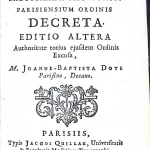
Ritus, et Insigniora Saluberrimi Medicorum Parisiensium Ordinis Decreta
Author
M. Joanne-Baptista Doye, Parisian Physician, Dean
Image
Description
A scarce early eighteenth-century Latin medical institutional work documenting the customs, ceremonies, statutes, decrees, and organizational traditions of the Paris Faculty of Medicine. Published in Paris in 1716 as an Editio altera, the volume offers a glimpse into the formal world of elite academic medicine before modern licensing boards, residency training, and contemporary medical bureaucracy.
Printed by Jacobi Quillau, printer to the University and Faculty of Medicine in Paris, the work reflects the rigid ceremonial structure and hierarchical culture of one of Europe’s most influential medical institutions. Rather than serving as a clinical handbook or therapeutic manual, this small-format volume preserves the rules, rituals, privileges, examinations, and institutional identity of organized medicine during the early Enlightenment period.
Works of this type are often overlooked compared with anatomy atlases and surgical texts, yet they provide valuable insight into how medicine functioned as an academic guild, social institution, and regulated profession in eighteenth-century Europe.
Condition
Small format volume, approximately 6 x 4 inches, in an early leather binding with expected age wear, rubbing, and handling consistent with a book exceeding three centuries of age. Decorative spine tooling remains partially visible. Marbled endpapers are present. Interior pages appear relatively clean and legible from examination photographs. Binding appears intact and displayable, with normal evidence of historical use.
Gallery
Historical context
The Faculty of Medicine of Paris was among the most influential medical authorities in Europe. By the early 1700s, medicine in Paris remained deeply rooted in university tradition, Latin scholarship, formal examinations, and ceremonial governance.
Medical education was not simply a matter of learning diagnosis and treatment. Advancement required navigating institutional rules, academic hierarchy, prescribed rituals, disputations, examinations, and administrative decrees. Works such as Ritus, et Insigniora… documented these practices and helped preserve the identity and authority of the medical profession.
This volume emerged during a period when medicine stood between older Galenic traditions and the scientific developments that would increasingly transform European medicine during the Enlightenment.
Curious Facts, Ephemera, and Trivia
This book predates the founding of the United States by roughly sixty years.
The work was printed entirely in scholarly Latin, the dominant language of learned European medicine.
Rather than teaching disease treatment, the book focuses on the ritual and administrative machinery of medicine itself.
Small institutional medical works such as this are often significantly rarer than major anatomy texts because they were printed for limited academic audiences.
No confirmed digital surrogate had been located by the owner at the time of cataloging; careful digitization using a CZUR scanning workflow is under consideration as a preservation effort.
Excerpt
Title page transcription:
Ritus, et insigniora saluberrimi Medicorum Parisiensium Ordinis Decreta.
Editio altera.
Parisiis, apud Jacobum Quillau, Typographum Juratum Universitatis, ac Facultatis Medicinae.
1716.
Why it is in the Cabinet
Medicine is more than anatomy plates, bottles, and surgical instruments. It is also an institution built on rules, hierarchy, tradition, examinations, authority, and ritual. This small Latin volume captures the administrative and ceremonial side of historical medicine — the machinery behind the physicians themselves. It represents the academic culture from which generations of European medicine emerged and preserves a seldom-seen aspect of medical history.
← Back to the Cabinet Directory
Support Dr. Bebout’s Cabinet of Medical Curiosities
If you enjoy the history, the oddities, and the effort, help keep this cabinet open. Every little bit helps preserve and share the strange wonders of medicine’s past.
Buy Me a Ko-fi ☕
Buy Me a Coffee ☕
Tip via PayPal 💵 [...]Read more...
05/26/2026Title
Pyramidon (Aminopyrine) Elixir – Winthrop Chemical Company
Author
Winthrop Chemical Company, Inc., New York, N.Y.
Image
Description
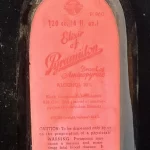
Amber glass pharmaceutical bottle with original red paper label for Elixir of Pyramidon Brand of Aminopyrine, manufactured by Winthrop Chemical Company, Inc. The bottle contained 120 cc (4 fl. oz.) of prescription-only aminopyrine elixir. The formulation lists 20% alcohol, approximately 43% sugar, and 0.18 grams (about 2½ grains) of aminopyrine per teaspoonful.
Pyramidon, also known as aminopyrine (amidopyrine), was a widely used mid-20th century analgesic and antipyretic medication employed for relief of pain, fever, rheumatic complaints, headaches, and related conditions. It belonged to the pyrazolone family of drugs descended from antipyrine chemistry.
What makes this example especially interesting is the prominent warning language printed directly on the manufacturer’s label:
“Pyramidon may cause a serious and sometimes fatal blood disease.”
That warning reflects growing medical recognition of agranulocytosis and severe bone marrow toxicity associated with aminopyrine use. Although once popular therapeutically, the drug eventually fell out of favor or was removed from use in many countries because of these potentially catastrophic adverse effects.
This bottle represents an important transition period in pharmaceutical history — no longer an unrestricted patent remedy, but not yet the fully modern era of drug safety regulation and pharmacovigilance.
Condition
Amber bottle with strong visual presentation and intact original label showing expected age-related wear, minor handling evidence, and surface aging. Label remains highly legible with excellent pharmaceutical display appeal.
Gallery
Historical context
Aminopyrine was introduced in the early 20th century as a potent pain- and fever-relieving drug. By the mid-1900s, accumulating clinical evidence linked the medication to potentially fatal blood dyscrasias, especially agranulocytosis, resulting in growing regulatory concern. Labels increasingly incorporated explicit physician supervision warnings, as seen on this example.
Curious Facts, Ephemera, and Trivia
Pyramidon was a trade name for aminopyrine / amidopyrine, a pyrazolone derivative related to antipyrine.
The label’s warning about fatal blood disease is unusually blunt by modern marketing standards.
The preparation contains 20% alcohol, not uncommon for liquid medicinal elixirs of the period.
The bottle was restricted to prescription sale only, reflecting recognition of significant pharmacologic risk.
Excerpt
“WARNING: Pyramidon may cause a serious and sometimes fatal blood disease. It should never be used except under strict and continuous medical supervision.”
Why it is in the Cabinet
Few pharmaceutical artifacts capture the uneasy balancing act between therapeutic enthusiasm and drug toxicity as clearly as Pyramidon. The bottle illustrates a once-accepted medication later recognized as medically dangerous, making it a strong example of evolving pharmaceutical safety and medical risk awareness.
← Back to the Cabinet Directory
Support Dr. Bebout’s Cabinet of Medical Curiosities
If you enjoy the history, the oddities, and the effort, help keep this cabinet open. Every little bit helps preserve and share the strange wonders of medicine’s past.
Buy Me a Ko-fi ☕
Buy Me a Coffee ☕
Tip via PayPal 💵 [...]Read more...
05/25/2026Title
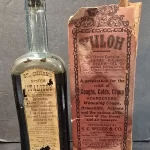
Dr. Shiloh’s System Vitalizer
Author
S. C. Wells & Co.Le Roy, New York / Toronto, Ontario
Image
Description
Dr. Shiloh’s System Vitalizer was a late nineteenth-century proprietary medicine marketed as a restorative tonic and corrective remedy for digestive, hepatic, and constitutional complaints. Produced by S. C. Wells & Co., the preparation was advertised for conditions including dyspepsia, liver complaint, habitual constipation, and general debility, reflecting the broad “system regulating” claims common among patent medicines of the era.
The surviving example consists of an embossed amber glass bottle accompanied by fragments of its original printed carton. The packaging preserves period advertising language, manufacturer information, and therapeutic claims directed toward chronic digestive and constitutional disorders. References to a guarantee or refund policy and multilingual packaging elements illustrate the aggressive marketing techniques employed by proprietary medicine companies during the late nineteenth century.
This item represents an era when tonic medicines occupied a major place in home therapeutics, often promising to restore vitality, improve digestion, purify the system, and strengthen weakened constitutions through proprietary formulations whose exact composition was frequently secondary to persuasive advertising.
Condition
Amber embossed bottle remains structurally sound with expected age wear. Original carton survives but is extremely fragile and heavily deteriorated, with severe tearing, losses, separation, and active disintegration. Despite poor condition, the surviving box remnants retain important historical packaging, labeling, and advertising information that substantially enhances the artifact’s interpretive value.
Gallery
Historical context
Patent medicines flourished in North America during the nineteenth century before modern pharmaceutical regulation. Manufacturers routinely marketed preparations for broad symptom clusters involving digestion, nerves, liver function, “impure blood,” weakness, and constitutional imbalance. Companies such as S. C. Wells & Co. relied heavily on recognizable branding, printed testimonials, guarantees, bold therapeutic claims, and visually distinctive packaging to build consumer confidence in crowded proprietary medicine markets.
Curious Facts, Ephemera, and Trivia
Le Roy, New York was home to several well-known nineteenth-century patent medicine manufacturers.
The surviving carton includes extensive printed advertising text — increasingly uncommon, as original boxes were usually discarded after purchase.
Multilingual packaging elements suggest broader marketing distribution beyond a strictly local American market.
“System” remedies were commonly marketed as medicines intended to regulate or revitalize the entire body rather than target a single disease.
Excerpt
From the surviving carton text:
“For Dyspepsia, Liver Complaint, Habitual Constipation…”
Why it is in the Cabinet
Patent medicine bottles are common; surviving original packaging is not. This example preserves not only the medicine container but fragments of the marketing language, therapeutic claims, and visual presentation that surrounded the product when sold. The deteriorated box tells part of the story — and in many ways may be rarer than the bottle itself.
← Back to the Cabinet Directory
Support Dr. Bebout’s Cabinet of Medical Curiosities
If you enjoy the history, the oddities, and the effort, help keep this cabinet open. Every little bit helps preserve and share the strange wonders of medicine’s past.
Buy Me a Ko-fi ☕
Buy Me a Coffee ☕
Tip via PayPal 💵 [...]Read more...
05/25/2026Title
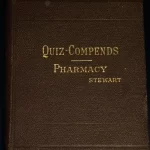
A Compend of Pharmacy (Quiz-Compends No. 11)
Author
F. E. Stewart, M.D., Ph.G.
Image
Description
A Compend of Pharmacy is a compact early twentieth-century pharmaceutical reference from Blakiston’s well-known Quiz-Compends series, intended for medical and pharmacy students requiring concise, examination-oriented instruction. Written by physician and pharmacist F. E. Stewart, the volume is based upon Joseph P. Remington’s Text-Book of Pharmacy and the United States Pharmacopoeia of 1890, reflecting the standards of American pharmaceutical education at the turn of the century.
This 1901 Fifth Revised Edition presents pharmacy in a highly condensed question-and-answer format. Topics include pharmaceutical metrology, heat and pharmaceutical operations, preparation methods, official preparations recognized by the United States Pharmacopoeia, inorganic and organic materia medica, and practical conversion tables for English and metric systems.
The work provides an excellent snapshot of pharmacy before the antibiotic era, when pharmacists routinely compounded preparations by hand and mastery of tinctures, extracts, syrups, powders, ointments, and official formulations was fundamental professional knowledge.
Condition
Original cloth binding with gilt spine and cover lettering. Moderate age-appropriate wear and rubbing to extremities. Interior appears clean and legible with expected toning from age. Solid collectible reference copy.
Gallery
Historical context
Blakiston’s Quiz-Compends were among the most recognizable medical student manuals of the late nineteenth and early twentieth centuries. Cheap, portable, and deliberately concise, they functioned as the medical equivalent of cram guides — small enough for a coat pocket but dense with facts intended to prepare students for examinations and clinical work. This pharmacy volume reflects an era when pharmacists were deeply involved in the preparation, standardization, and dispensing of medicinal products rather than simply distributing pre-manufactured medications.
Curious Facts, Ephemera, and Trivia
This book is Quiz-Compends No. 11 in Blakiston’s educational series.
It is based upon Remington’s Text-Book of Pharmacy — a work whose descendants remain influential today as Remington: The Science and Practice of Pharmacy.
The text relies upon the United States Pharmacopoeia of 1890, preserving pharmaceutical standards from an era of tinctures, fluid extracts, collodions, cerates, troches, and compound preparations.
The publisher advertised the series as manuals that students could “use in any college,” emphasizing portability, brevity, and exam preparation.
Excerpt
From the classification of official preparations:
“Made without percolation or maceration… Waters, Solutions… Spirits, Elixirs… Collodions… Powders, Triturations, Masses, Confections, Pills, Troches, Cerates, Ointments, Plasters, Papers, Suppositories.”
Why it is in the Cabinet
This volume captures pharmacy in its practical, hands-on era — before industrial pharmaceuticals transformed the profession. It belongs in the Cabinet as both a student survival manual and a compact record of historical American drug preparation, nomenclature, and pharmaceutical education.
Digital Edition / External Digital Copy
A digital edition of this work has been added to the Cabinet collection for research, preservation, and reference use.
View / Download Digital Copy:A Compend of Pharmacy
Format: Searchable PDF (OCR processed)
Digital Source:Internet Archive / external archival source.
Original Physical Source:External digitization; preserved as part of the Cabinet’s digital medical library collection.
Usage Note:This digital preservation copy is provided for historical research, educational use, and medical history reference purposes.
← Back to the Cabinet Directory
Support Dr. Bebout’s Cabinet of Medical Curiosities
If you enjoy the history, the oddities, and the effort, help keep this cabinet open. Every little bit helps preserve and share the strange wonders of medicine’s past.
Buy Me a Ko-fi ☕
Buy Me a Coffee ☕
Tip via PayPal 💵 [...]Read more...
05/22/2026Title
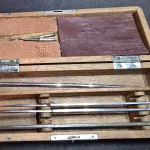
Tiemann Surgical Instrument Kit in Wooden Case
Author
Manufactured by Tiemann & Co., New York
Image
Description
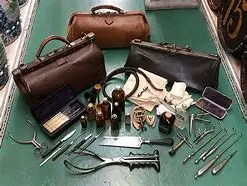
This late 19th to early 20th century surgical instrument kit was manufactured by Tiemann & Co., one of the most respected American makers of surgical and medical instruments during the Victorian and early modern medical era. The compact wooden carrying case contains several steel surgical knives or scalpels of varying blade profiles, interchangeable threaded instrument tips, and long probe-like instruments arranged in fitted compartments.
The interior retains remnants of its original felt or velvet lining, and the exterior bears a handwritten ownership inscription reading “F.E. Tapman” (or similar), likely identifying the physician or medical student who once owned the kit. The knives remain remarkably sharp despite their age, reflecting the quality of surgical steel and the expectation that instruments of the era would be repeatedly sharpened, sterilized, and reused throughout a physician’s career.
The exact specialty use of the kit is uncertain, but it was likely intended for minor surgery, dissection, ENT work, ophthalmic procedures, or general medical practice. The varying blade shapes and interchangeable components suggest a practical field or office surgical set rather than a decorative display piece.
Condition
Complete wooden case with moderate age wear, scratches, and handling marks consistent with age and medical use. Interior lining shows wear and deterioration. Instruments retain original patina and oxidation with scattered spotting and surface discoloration. Several blades remain extremely sharp. The set appears partially incomplete but retains strong historical integrity and display appeal.
Gallery
Historical context
George Tiemann & Co. was founded in New York in the 19th century and became one of the premier American manufacturers of surgical, dental, orthopedic, and military medical instruments. Tiemann instruments were widely used by physicians and surgeons during a period when medicine was transitioning from crude pre-antiseptic surgery into more modern operative practice.
Before disposable instruments became standard, surgical tools were valuable professional investments that were maintained, sharpened, and reused for decades. Compact surgical kits like this were often carried directly to homes, clinics, or hospital wards by physicians making house calls or performing office procedures.
Curious Facts, Ephemera, and Trivia
Surgical instruments from this era were frequently hand-finished and made from high-quality carbon steel capable of taking extremely fine edges.
Razor-sharp scalpels were considered essential because faster, cleaner incisions reduced tissue trauma and patient suffering before modern anesthesia and antibiotics.
Tiemann supplied instruments during the Civil War era and later became one of the dominant American surgical instrument houses.
Many surviving antique surgical kits have been over-polished by collectors. This example retains its original aged appearance and authentic medical character.
Excerpt
“Not every antique medical instrument tells you what it was used for. Some simply sit there quietly and let your imagination do the rest.”
Why it is in the Cabinet
This set represents the reality of historical medicine — practical, reusable, personal, and slightly intimidating. The worn case, surviving sharpness, and evidence of long-term use give the impression of a real working physician’s instrument kit rather than a decorative curiosity. It captures the transition period between Victorian medicine and the beginnings of modern surgery, making it a perfect fit for the Cabinet of Medical Curiosities.
← Back to the Cabinet Directory
Support Dr. Bebout’s Cabinet of Medical Curiosities
If you enjoy the history, the oddities, and the effort, help keep this cabinet open. Every little bit helps preserve and share the strange wonders of medicine’s past.
Buy Me a Ko-fi ☕
Buy Me a Coffee ☕
Tip via PayPal 💵 [...]Read more...