
Title
Doan’s Pills – Vintage Backache Relief Tins (85-count and 40-count)
Image

Description
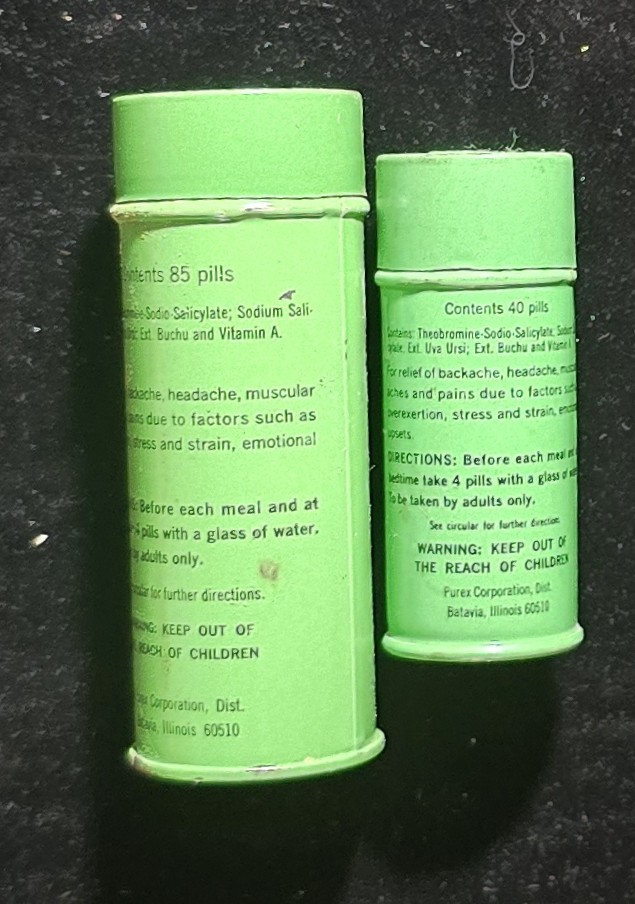
Two vivid green tins of Doan’s Pills, a once-popular over-the-counter remedy “for the relief of backache.” Marketed for muscular pain, stress-related discomfort, and kidney complaints, Doan’s Pills became a household name in the 20th century. These tins—one labeled to contain 85 pills and the other 40—were distributed by Furex Corporation of Batavia, Illinois, and are notable for their embossed metal pills and classic cylindrical packaging.
The active ingredients listed include theobromine-sodium salicylate, sodium salicylate, extract of uva ursi, buchu, and vitamin A—an herbal and chemical blend common in kidney and urinary treatments of the era. Doan’s Pills were widely advertised in newspapers, almanacs, and radios throughout the early-to-mid 1900s.
Condition
Both tins are intact with readable labels. The green coating is worn in places, especially around the edges and rims.
Gallery

Historical context
Doan’s Pills originated in the late 19th century, originally promoted by Foster-Milburn & Co. of Buffalo, New York. They were among many “kidney pills” marketed to a population suffering from the aches and strains of industrial work, poor posture, and long hours on their feet. In a time when backache and fatigue were often attributed to kidney sluggishness, Doan’s built its brand on a potent narrative: that healthy kidneys meant a pain-free life.
As the American workforce transitioned from manual labor to office settings in the 20th century, the language around the product shifted. The emphasis moved toward relief from back strain, overexertion, and tension, but the kidney connection remained central until FDA scrutiny in the 1990s forced label changes.
The company’s marketing was so pervasive that Doan’s became a household name, despite medical professionals often questioning its efficacy.
Curious Facts, Ephemera, and Trivia
The Doan’s name has no verifiable connection to any known physician, despite its clinical air. It’s likely a fabrication—a common tactic in the era of patent medicine to add an aura of credibility.
Buchu and uva ursi, the herbs included in the formula, were both common in 19th-century “kidney tonics” and survive today in herbal supplements, though clinical evidence of their effectiveness is limited.
One early ad claimed:
“Doan’s Pills act directly on the kidneys. They give prompt relief and permanent benefit.”
The U.S. government filed suit against Doan’s in 1996, challenging its longstanding kidney-related claims. As a result, modern versions of the product no longer refer to kidney function at all.
Excerpt
rom a 1939 Foster-Milburn ad in Popular Mechanics:
“Backache may be nature’s warning that your kidneys need attention. Thousands have found quick relief with Doan’s Pills, the time-tested remedy trusted for over 50 years.”
Why it is in the Cabinet
These tins represent the golden age of patent medicine marketing, when pain relief was repackaged as kidney support, and science blurred with suggestion. Their durable design, bold color, and preserved contents make them a striking visual artifact—but more importantly, they embody the cultural narrative of back pain as a medical mystery, explained (rightly or wrongly) by kidney trouble. Their survival tells a story of shifting medical authority, public trust, and commercial ingenuity—hallmarks of medical ephemera worthy of preservation.
Support Dr. Bebout’s Cabinet of Medical Curiosities
If you enjoy the history, the oddities, and the effort, help keep this cabinet open. Every little bit helps preserve and share the strange wonders of medicine's past.
Buy Me a Ko-fi ☕ Buy Me a Coffee ☕ Tip via PayPal 💵