
Hospital Prescription for Strychnine Nitrate Tablets
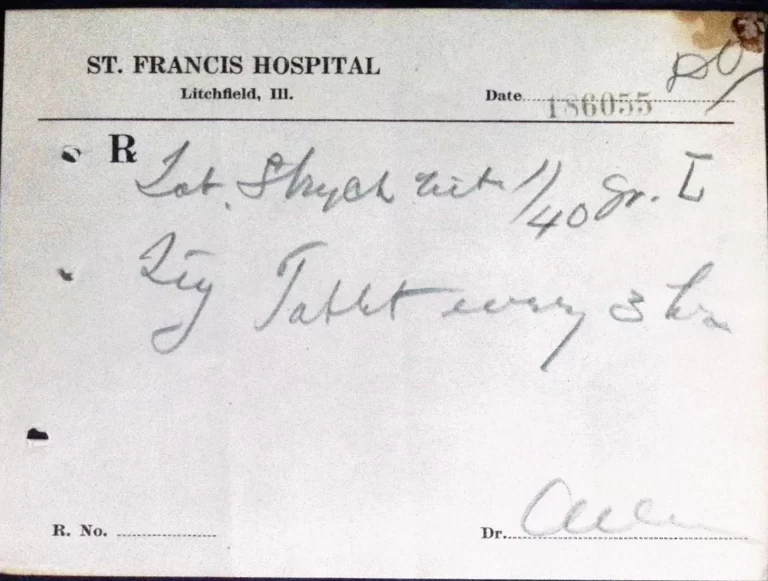
Prescribing Doctor: Unknown
Patient Name: Unknown
Pharmacy: St. Francis Hospital
Date: Undated
Location: Litchfield, Il
Transcription
℞
℞ Strych. Nit. 1/40 gr.
Sig: Tablet every 3 hrs
Interpretation
The medication prescribed was strychnine nitrate, a pharmaceutical preparation of strychnine once used as a circulatory stimulant, nervous system tonic, appetite stimulant, and general restorative. The prescribed strength of 1/40 grain corresponds to approximately 1.6 milligrams.
Although modern audiences associate strychnine almost exclusively with poisoning, physicians continued prescribing small therapeutic doses well into the twentieth century. This prescription serves as a reminder that many substances now considered dangerous once occupied legitimate places within everyday medical practice.
The form bears the printed name of St. Francis Hospital and an unidentified handwritten physician signature. A purple stamped number is present but its meaning remains uncertain and may represent a hospital or pharmacy control number rather than a date.
Condition
Good condition. Original prescription form remains intact with moderate age toning and minor edge wear. Handwriting is legible with some fading. Hospital letterhead remains clear and easily readable.
Historical Context
Strychnine was derived from the seeds of Strychnos nux-vomica and entered Western medicine during the nineteenth century. In small doses it was believed to stimulate the nervous system and improve appetite, digestion, and general vitality. By the mid-twentieth century its use was declining as safer and more effective medications became available. Eventually strychnine disappeared from routine medical practice altogether.
Curious Facts and Trivia
- Strychnine was once included in numerous official pharmacopeias and medical formularies.
- Small doses were commonly prescribed for fatigue, weakness, poor appetite, and certain neurological disorders.
- Competitive athletes occasionally experimented with strychnine as a stimulant in the late nineteenth and early twentieth centuries.
- The difference between a therapeutic and toxic dose was relatively narrow, contributing to its eventual abandonment.
- Most people today are surprised to learn that hospitals and physicians routinely prescribed strychnine within living memory.
Callout Box
⚠️ Caution: Medicine’s Most Famous Poison
Strychnine is remembered today as one of history’s most notorious poisons, capable of causing severe muscle spasms, convulsions, and death in sufficiently high doses. Yet for decades physicians prescribed carefully measured amounts as a legitimate medicine. This prescription for 1/40 grain strychnine nitrate tablets serves as a reminder that the line between remedy and poison was often surprisingly thin in historical medical practice. The old pharmacological principle still applied: “The dose makes the poison.”
Why It’s in the Cabinet
This prescription captures a forgotten chapter of pharmaceutical history. It documents a period when one of history’s most infamous poisons was still recognized as a legitimate medicine. Items like this bridge the gap between modern pharmacology and the often surprising realities of earlier medical practice.
Support Dr. Bebout’s Cabinet of Medical Curiosities
If you enjoy the history, the oddities, and the effort, help keep this cabinet open. Every little bit helps preserve and share the strange wonders of medicine's past.
Buy Me a Ko-fi ☕ Buy Me a Coffee ☕ Tip via PayPal 💵