The Ghost of Formalin
Or: How a Smell Pulled Me 30 Years Into the Past
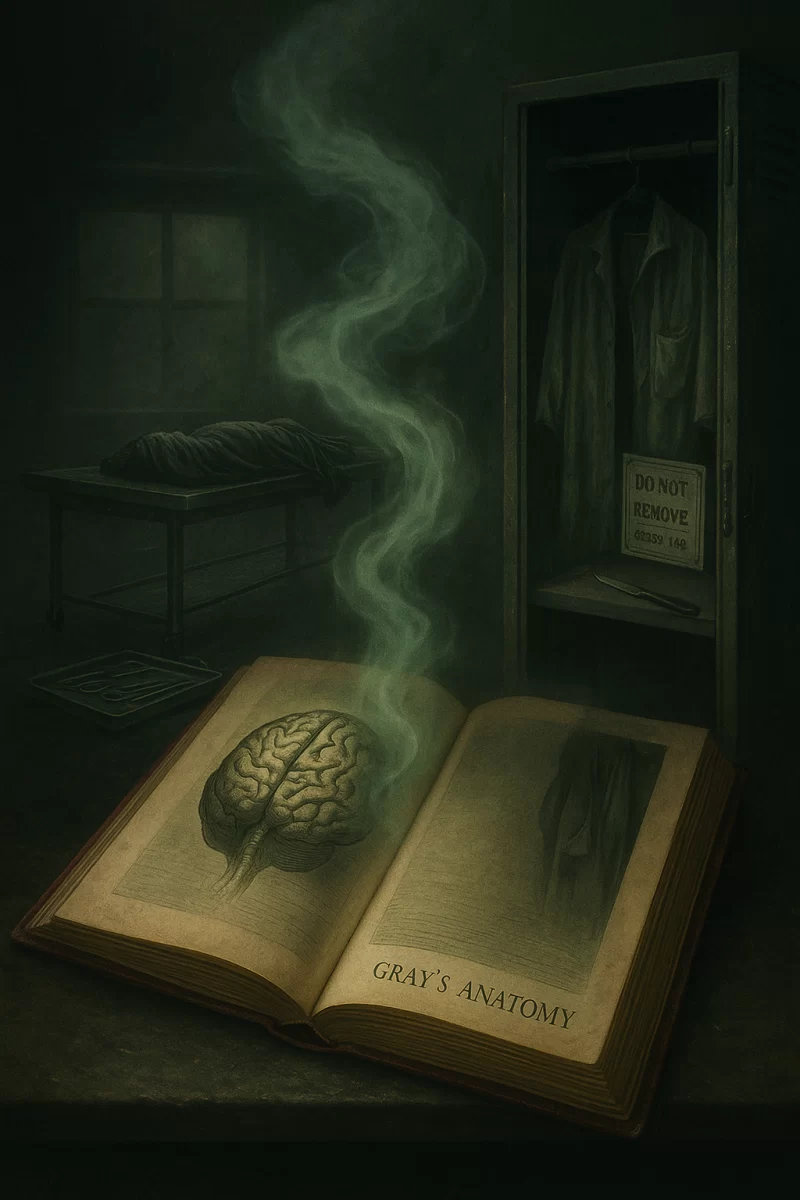
I was flipping through the 20th edition of Gray’s Anatomy—a hundred-year-old tome with brittle pages and tissue-thin illustrations—looking for images I could scan. Maybe for a coloring book. Maybe for wall art. Maybe just to feel a little closer to the medicine of the past.
And then I smelled it.
Not paper. Not mildew. Not the usual scent of old books.
Formalin.
Just for a second.
Then it was gone.
But in that brief moment, I was back in Gross Anatomy lab—decades and miles away—and everything came flooding back.
What Exactly Is Formalin?
Formalin is the liquid form of formaldehyde, a potent chemical preservative. Formaldehyde on its own is a gas; dissolve it in water, and you get formalin.
It’s used to kill bacteria, fix human tissue, and prevent decay. It saturates a cadaver and keeps it preserved at room temperature—firm, stable, and scientifically usable for months or years. That’s why it’s the universal preservative in medical school dissection labs.
And it has a smell—one you never forget.
Sharp. Penetrating. Pungent. It doesn’t just linger—it invades. It sinks into your clothes, your hair, your skin, your memory.
Gross Anatomy: The Rite of Passage
Gross Anatomy is probably the most feared, most anticipated, and most unforgettable class in all of medical school. It’s where you meet death as a student, and learn to approach it with respect, curiosity, and precision. It’s where you make your first cut—not into a diagram, but into a real human being.
Every cadaver you work on has been legally donated to science. After death, the blood is drained, the body is embalmed, and the entire circulatory system is pumped full of formalin. Then it’s stored—sometimes for a year or more—in vats of formalin until it’s ready to be assigned to a student team.
You walk into a cold lab full of steel tables. Each one has a body bag.
You unzip it. That’s your first real patient.
Before you even see the face, you’re hit with that unmistakable wall of formalin. And that’s when you understand why they told you to always wear the same clothes.
💀 Things You Don’t Learn in Lecture: Why We Burned Our Clothes
In Gross Anatomy lab, we didn’t wear our normal clothes. We had a designated outfit—a set of scrubs, old shoes, gloves, protective eyewear—and those items never left the lab.
We’d change in the locker room, wear the same scrubs for the whole semester, and hang them back up each day.
We didn’t wash them.
We didn’t take them home.
We didn’t even consider it.
Because formalin saturates everything. You carry the smell with you, whether you want to or not. You walk down the hall and people know—you’ve been in lab.
I kept my gear in a locker: a pair of surgical scrubs, old tennis shoes, and a quietly developing cloud of chemical decay.
At the end of the semester, we had a small, unspoken ceremony.
We burned them.
You don’t wear your Gross Anatomy clothes again.
You don’t want to.
They’ll never stop smelling like death.
The Power of Scent and Memory
Smell is the strongest trigger for emotional memory. The olfactory bulb—the part of the brain that processes scent—is wired directly into the limbic system, the region responsible for memory and emotion. It bypasses the usual filters of logic and language. That’s why it can hit you so hard. So suddenly.
You smell fresh-cut grass, and you’re nine years old again in your backyard.
You smell cinnamon and you’re back in your grandmother’s kitchen, watching pie crust bubble in the oven.
And if you’ve ever been through Gross Anatomy?
You smell formalin, and you’re back at that table.
That cold room.
That first incision.
That first confrontation with your own mortality.
What Happened to Me
That day, flipping through Gray’s Anatomy, I wasn’t expecting much—maybe a few diagrams I hadn’t noticed before. Maybe a label worth enlarging. Maybe something useful for the Cabinet.
But instead, I got hit with a memory so strong it felt like time travel.
I smelled formalin—not in the air, not in the book, but in my brain.
Just for a second. But in that second, I was there again.
Gross Anatomy Lab.
Steel table.
Body bag.
Unzipping.
The smell.
And then it was gone. I sat there, holding the book, staring straight ahead, thinking:
“Holy shit. What was that?”
I’ve never had a memory hit me like that before. Not from a photo. Not from a song. Not from a story.
I have trouble remembering parts of my childhood.
But in that moment, I remembered Gross Anatomy with absolute clarity.
If you’ve never had the, let’s say, pleasure of dissecting a cadaver, but you’re curious about what that experience is like—from both a scientific and human perspective—I highly recommend the book Stiff: The Curious Lives of Human Cadavers by Mary Roach. It’s a brilliant and often darkly funny exploration of what happens to the human body after death, especially in medical education. Roach manages to capture the gravity, the absurdity, and the scientific wonder of it all in a way that hits remarkably close to home.
What the Mind Preserves
I spend a good part of my life preserving things—old books, surgical tools, medicine bottles, prescriptions. I scan them. I document them. I give them a second life in the Cabinet.
But it turns out the mind preserves things too.
And sometimes—when you least expect it—it throws one back at you.
A scent. A sound. A flicker of paper.
And suddenly, you’re not in your office anymore.
You’re not holding a book.
You’re 25 again. And you’re standing over your first cadaver.
Memory isn’t just recall.
Sometimes, it’s a haunting.
Sometimes, it’s a gift.
And sometimes, it smells like formalin.
For a detailed catalog entry of the original bottle, see Formalin (Formaldehyde Solution) — Schering & Glatz
Support Dr. Bebout’s Cabinet of Medical Curiosities
If you enjoy the history, the oddities, and the effort, help keep this cabinet open. Every little bit helps preserve and share the strange wonders of medicine's past.
Buy Me a Ko-fi ☕ Buy Me a Coffee ☕ Tip via PayPal 💵
Very interesting! I’m getting the book you recommended. Thanks for sharing.