
The First Time I Cut a Throat
A moment in trauma medicine I’ll never forget—and why you should never take your training for granted.
There are many “firsts” in a medical career.
The first time you take care of a patient on your own.
The first time you do CPR.
The first time you sew somebody up.
The first time you deliver a baby.
And the first time… you cut someone’s throat.
I trained at a solid medical school. Completed a rigorous residency. And then spent years tailoring my practice to meet the needs of real-world medicine—community-based, often chaotic, always unpredictable. One of the smartest decisions I ever made was enrolling in Advanced Trauma Life Support (ATLS). I didn’t just take the course—I recertified three times. It certifies you in trauma care for four years. It’s the kind of course you hope you never need.
But one day, I did.
I was working a shift in a small-town ER. And just like big-city trauma centers, small-town ERs can see disaster. The ambulance call came from a nearby long-term care facility that housed residents with intellectual and developmental disabilities.
The report: “Young female, choking, unable to establish airway.”
She arrived via screaming ambulance into trauma room one. No pulse. No respirations. No airway.
Try as I might, I couldn’t intubate. Something was blocking the airway. We were told she had choked during lunch. I tried everything. Laryngoscope. Endotracheal tube. Ring forceps. But there was no path forward.
There was only one option left.
If I had any chance of saving her life, I had to perform a cricothyroidotomy—cutting directly into the neck to establish an airway. It’s the kind of thing you train for in ATLS. Practice on pigs. Mannequins. Maybe cadavers.
But this was real.
I grabbed a #11 blade. Located the cricothyroid membrane. My training told me to cut vertically—but in the rush, I made a horizontal incision. It wasn’t a catastrophic error; the cut was still wide enough. I plunged through the membrane, finger in the hole, widened it, and inserted a size 6 endotracheal tube.
Immediate airway.
Bagged. Ventilated.
But it was too late.
She was already gone. There was no bringing her back. She had been gone before she ever reached us.
And that wasn’t the end.
Because it was an institutional death, the coroner was involved. He told me:
“If you can remove the obstruction, we may be able to skip the autopsy.”
The culprit?
A piece of chicken.
I tried and tried—ring forceps, long clamps—but the obstruction was so tightly wedged, I could only remove tiny fragments. Never the full piece. So sadly, the young woman still underwent an autopsy… to confirm what we already knew.
Final Reflection
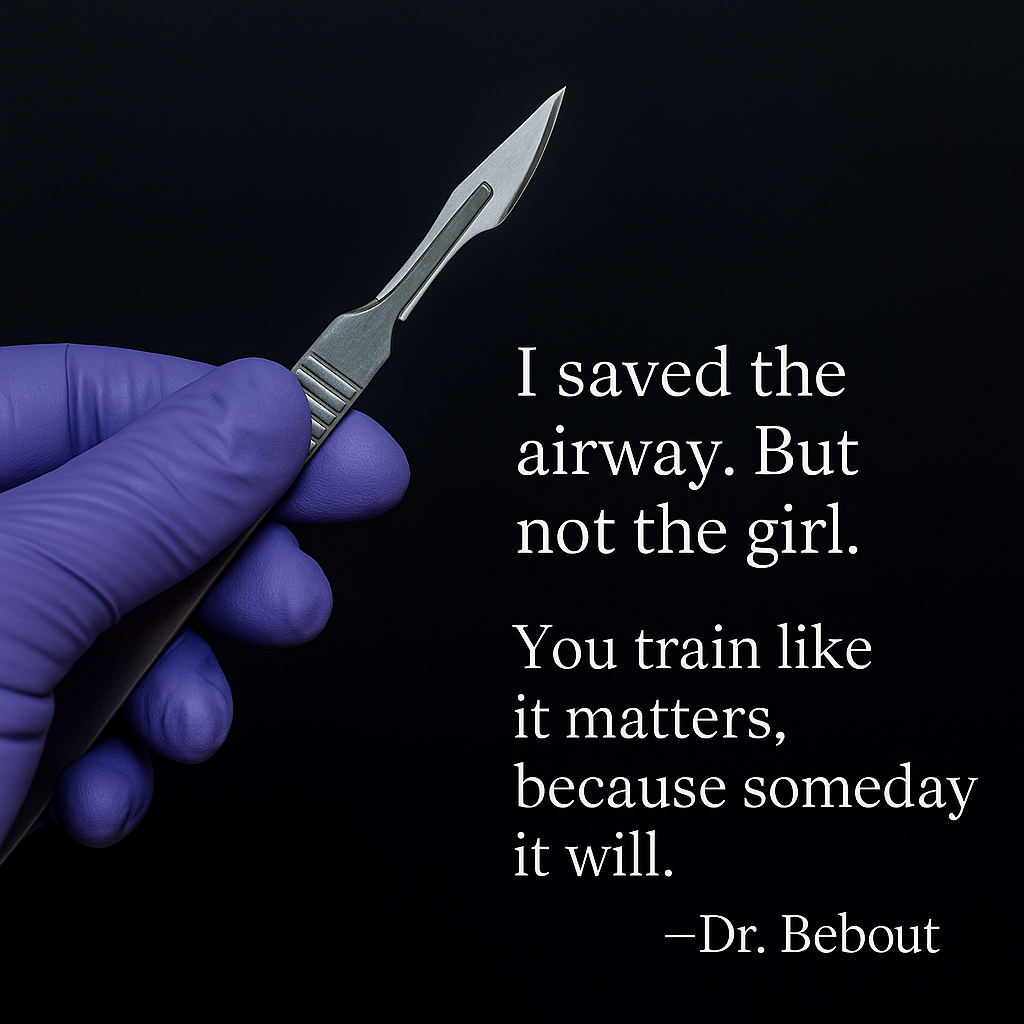
I saved the airway. But not the girl.
And I’ve carried that ever since—not as failure, but as a reminder:
you train like it matters, because someday it will.
Author Credit:
—Dr. Bebout, Family and Emergency Medicine
Support Dr. Bebout’s Cabinet of Medical Curiosities
If you enjoy the history, the oddities, and the effort, help keep this cabinet open. Every little bit helps preserve and share the strange wonders of medicine's past.
Buy Me a Ko-fi ☕ Buy Me a Coffee ☕ Tip via PayPal 💵
Don’t get to comfortable, anything can walk in at any moment.
Don’t I know it. 30+ years of practicing medicine has taught me that much!