
Prescription Archives Entry No. 14496
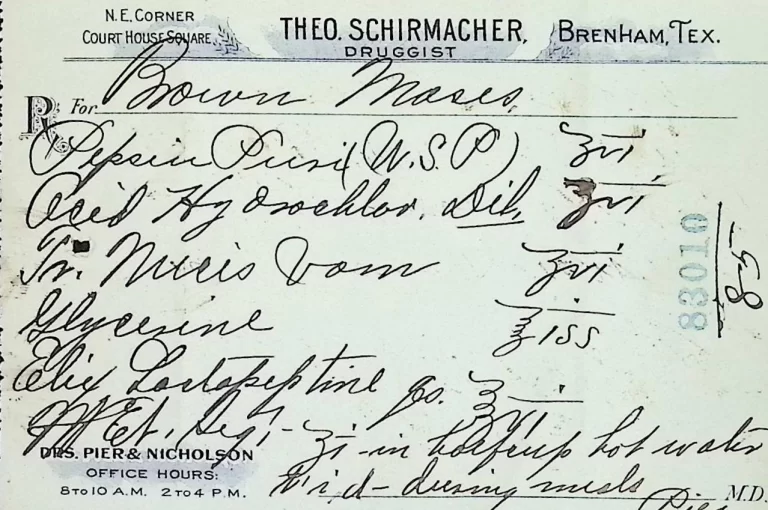
Date: Undated (Estimated late 19th to early 20th century)
Pharmacy: Theo. Schirmacher, Druggist – Brenham, Texas
Patient: Brown Moses
Physicians: Drs. Pier & Nicholson
Transcription
Pepsin Puri (U.S.P.) – ʒii
Acid Hydrochlor. Dil. – ʒii
Tn Mucis Vom – ʒii
Glycerine – ʒiss
Elix Lactopeptine – ℥ss
Sig: ℥i in ½ cup hot water
T.I.D. during meals.
Interpretation
Pepsin Purified (U.S.P.) – A digestive enzyme used to aid in the breakdown of proteins in the stomach.
Diluted Hydrochloric Acid (U.S.P.) – Supplemented stomach acid for patients with hypochlorhydria (low stomach acid), often thought to help with digestion and absorption.
Tinctura Mucis Vomicae (Nux Vomica) – A bitter stimulant, historically used for digestion and sluggish GI activity, though toxic in high doses due to strychnine content.
Glycerin – A soothing demulcent, often included in elixirs and syrups for smoothing harsh ingredients.
Elixir Lactopeptine – A proprietary mixture used in the late 1800s–early 1900s, combining digestive enzymes and lactic acid ferments, commonly advertised as a remedy for dyspepsia and malabsorption.
Sig: “Take one ounce in a half cup of hot water three times daily during meals.”
Condition
Good condition. Legible with light staining and partial ink fading. Pharmacist and physician names clearly readable. Includes stamped script number (83010) and elegant cursive handwriting typical of the era.
Historical Context
This compound prescription is a classic example of turn-of-the-century treatment for chronic indigestion, gastric insufficiency, or possibly “nervous dyspepsia.” The inclusion of hydrochloric acid and pepsin reflects the prevailing belief that many digestive disorders stemmed from a lack of proper gastric juices.
The presence of Nux Vomica and Lactopeptine suggests this was compounded for someone with chronic digestive sluggishness, poor nutrient absorption, or possibly even functional dyspepsia—a catch-all diagnosis common at the time.
Curious Facts and Trivia
Lactopeptine was heavily marketed as a miracle remedy and was often recommended by name in medical journals of the late 1800s.
Nux Vomica was considered a stimulant tonic despite containing strychnine—a substance now associated with poisoning.
Glycerine was commonly used as a carrier or preservative in elixirs due to its soothing and stabilizing properties.
Brenham, Texas, where this prescription originated, was a bustling hub in the late 19th century with several prominent druggists like Theo. Schirmacher, who operated near the courthouse square.
Callout Box
⚠️ Caution: This Digestive Aid Contained Strychnine
Tincture of Nux Vomica, listed as Tn Mucis Vom, was a common ingredient in digestive tonics of the late 19th century. Derived from the seeds of the Strychnos nux-vomica tree, it contained strychnine, a powerful nervous system stimulant—and a known poison.
Used in tiny doses, it was believed to improve appetite, digestion, and even treat “nervous exhaustion.” But just a few drops too much could cause tremors, convulsions, or worse. It’s a sobering reminder that the line between medicine and poison was often walked with blindfolded confidence.
Why It’s in the Cabinet
This prescription captures the unique blend of pharmaceutical empiricism and early commercial patent formulations that characterized late 19th-century American druggists. It reflects a period where physicians prescribed by compound formulation rather than brand name—and where elixirs, acids, and stimulants mingled freely in search of relief from chronic ailments.
Support Dr. Bebout’s Cabinet of Medical Curiosities
If you enjoy the history, the oddities, and the effort, help keep this cabinet open. Every little bit helps preserve and share the strange wonders of medicine's past.
Buy Me a Ko-fi ☕ Buy Me a Coffee ☕ Tip via PayPal 💵