
Title
Peruna 3-Way Action Stomachic Iron Tonic and Expectorant (ca. 1950s)
Author
Consolidated Royal Chemical Corporation, Chicago, Illinois
Image
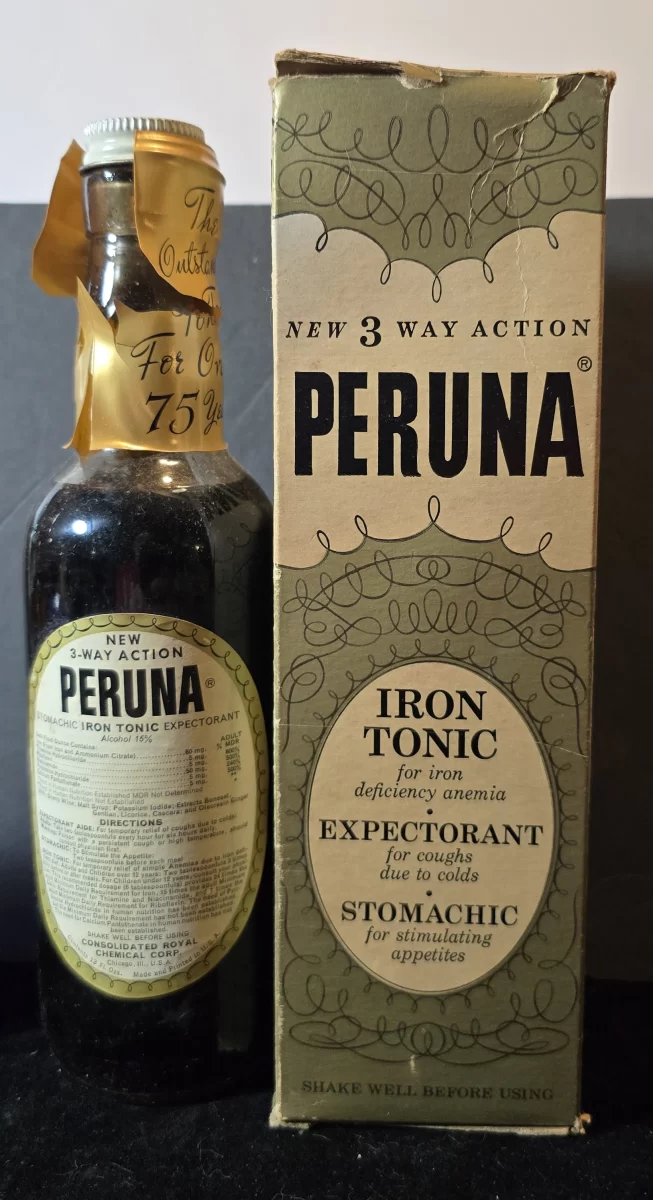
Description
This boxed bottle of Peruna 3-Way Action represents the later evolution of one of America’s most notorious patent medicines. Originally launched in 1898 by Dr. Samuel B. Hartman of Columbus, Ohio, Peruna was first marketed as a cure for catarrh—a vague term covering nearly any chronic ailment. By the mid-20th century, after federal regulations curtailed unsubstantiated medical claims, Peruna re-emerged as a “Stomachic Iron Tonic and Expectorant,” boasting “New 3-Way Action” for appetite, anemia, and coughs due to colds.
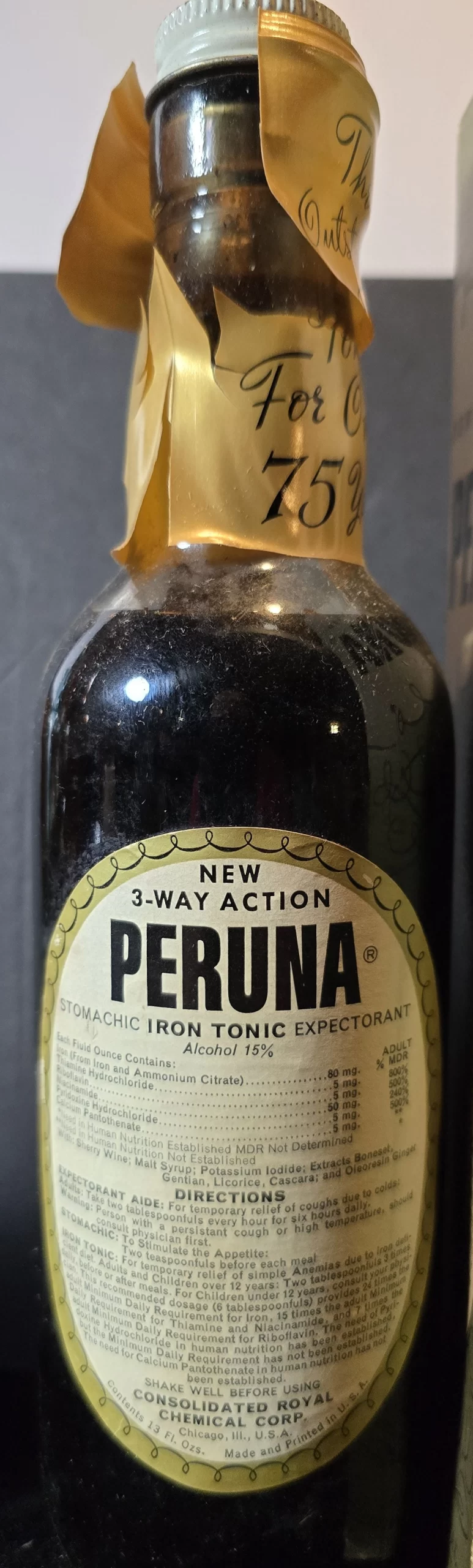
This bottle’s label lists vitamins B1, B2, B3, B6, and B5 alongside herbs such as gentian, licorice, cascara, and oleoresin ginger—all suspended in a base of sherry wine and malt syrup. The alcohol content of 15 % ensured that consumers felt “better” almost immediately.
Condition
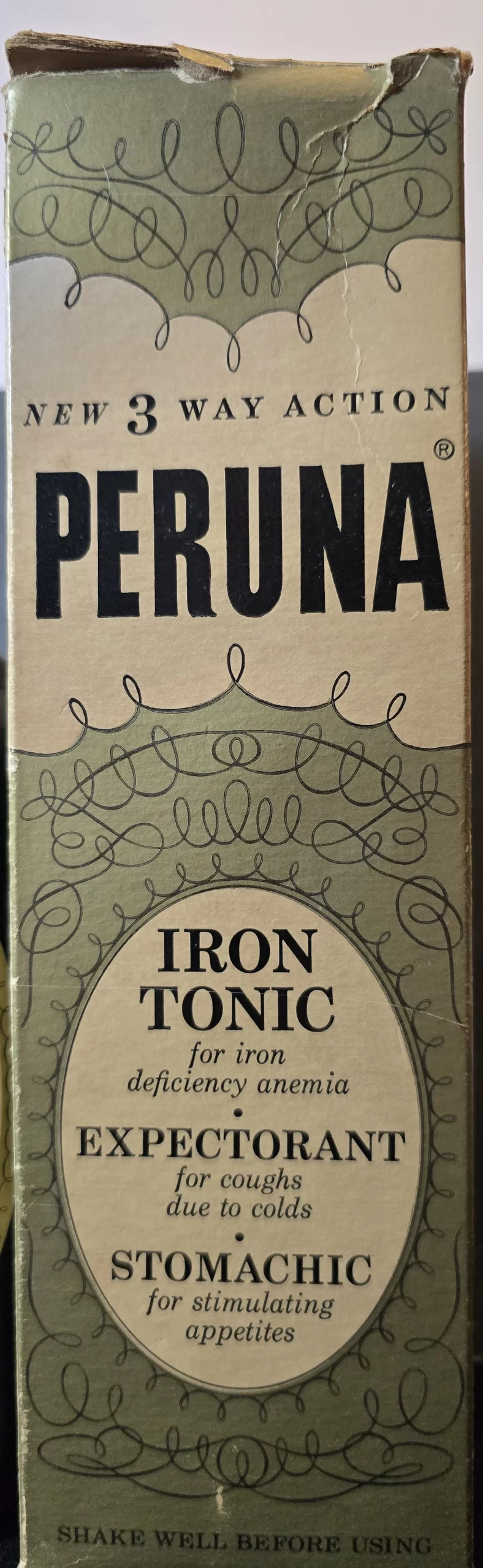
Excellent display condition with intact gold foil neck seal reading “The Outstanding Tonic for Over 75 Years.” Box shows moderate creasing and light edge wear; label is bright and legible. The bottle remains sealed with partial liquid contents visible.
Gallery



Historical context
Peruna’s long life traces the shifting landscape of American medicine. In its early days it was promoted as a panacea for catarrh, influenza, and female complaints, its creator publishing testimonials and distributing calendars, postcards, and even political endorsements under the “Peruna brand.” By the 1930s and ’40s, increased scrutiny by the FDA forced manufacturers to reformulate and rebrand such tonics as “vitamin supplements.”
The “3-Way Action” claim seen on this mid-century bottle reflects post-WWII marketing trends emphasizing vitamins and iron to suggest scientific legitimacy. Despite the sanitized language, the product’s composition remained fundamentally similar to its patent-medicine ancestor—an alcoholic tonic spiked with iron and bitters.
Curious Facts, Ephemera, and Trivia
Early advertising claimed Peruna could “build up the mucous membranes” and “restore manhood.”
Politicians once praised it publicly—most famously U.S. Senator Joseph B. Foraker of Ohio, who reportedly endorsed it during a re-election campaign.
During Prohibition, Peruna maintained strong sales as a “medicinal” source of alcohol.
The later “Royal Chemical Corp.” labeling marks its transition from folk remedy to vitamin tonic, likely dating from the 1948–1955 period.
Excerpt
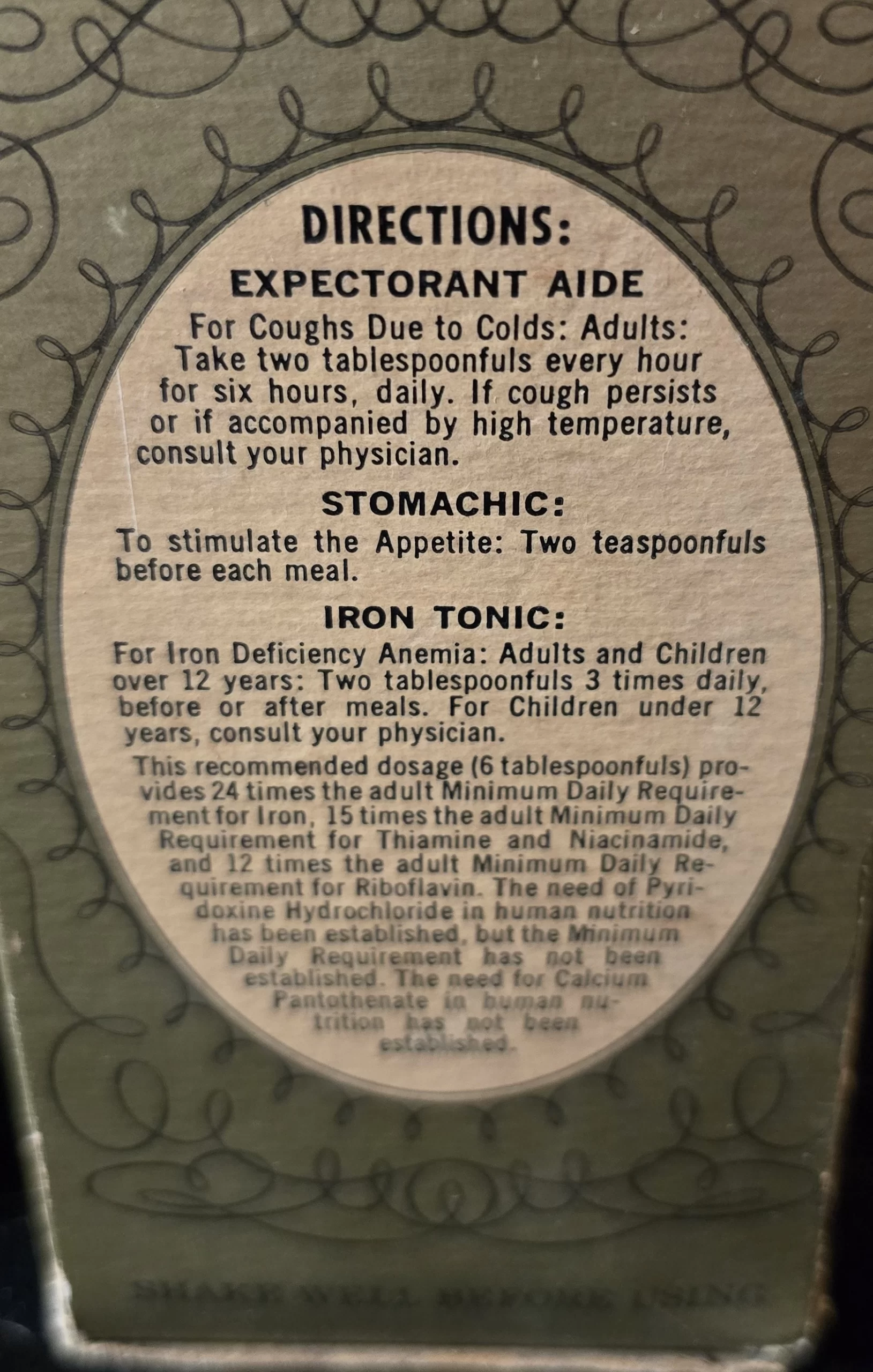
“NEW 3 WAY ACTION PERUNA — STOMACHIC IRON TONIC EXPECTORANT.
Iron Tonic for iron deficiency anemia · Expectorant for coughs due to colds · Stomachic for stimulating appetites.”
“Each fluid ounce contains: Iron (from Iron and Ammonium Citrate) 80 mg, Thiamine Hydrochloride 5 mg, Riboflavin 5 mg, Niacinamide 50 mg, Pyridoxine Hydrochloride 5 mg, Calcium Pantothenate 5 mg. With Sherry Wine, Malt Syrup, Potassium Iodide, Extracts of Boneset, Gentian, Licorice, Cascara, and Oleoresin Ginger. Alcohol 15 %.”
“The Outstanding Tonic for Over 75 Years.”
Why it is in the Cabinet
This bottle bridges two eras of American medicine: the flamboyant age of patent cures and the regulated era of vitamin supplements. Its survival in box and foil represents not only a piece of advertising art but also a symbol of how public faith in tonics persisted long after modern science proved otherwise. It stands as a handsome artifact from the golden age of medical marketing.
Support Dr. Bebout’s Cabinet of Medical Curiosities
If you enjoy the history, the oddities, and the effort, help keep this cabinet open. Every little bit helps preserve and share the strange wonders of medicine's past.
Buy Me a Ko-fi ☕ Buy Me a Coffee ☕ Tip via PayPal 💵