
Paregoric and Bismuth Mixture – Dr. Olivier Caza, Skowhegan, Maine (1919)
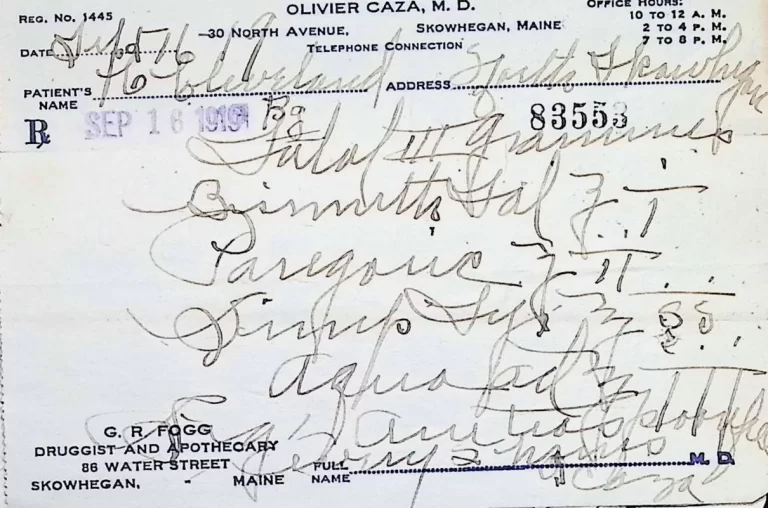
Prescribing Doctor: Dr. Olivier Caza
Patient Name: H. Cleveland (partial name, unclear)
Pharmacy: G. R. Fogg, Druggist and Apothecary
Date: September 16, 1919
Location: Skowhegan, Maine
Transcription
℞
[Unclear: Possibly “Sulol” or similar] gr. iii
Bismuth Sal. ʒi
Paregoric ʒii
Syr. [Simplex?] ʒiii
Aqua q.s. ad ℥ii
Sig: [Unclear, likely dosage instructions]
Interpretation
This 1919 prescription appears to be a compound stomach remedy, blending ingredients with calming, anti-inflammatory, and antidiarrheal properties.
Bismuth Salicylate – recognizable as a GI soother and antibacterial
Paregoric – camphorated tincture of opium, used to calm intestinal spasms
Syrup and aqua – diluents and sweeteners for palatability
One ingredient (likely the first listed) is uncertain. It may be a trade name or shorthand for a discontinued compound, possibly an intestinal antiseptic or bitter tonic—but its identity remains unconfirmed.
This was likely dispensed as a 2-ounce liquid, taken by the teaspoon.
Condition
Dated September 16, 1919 with a clear ink stamp. Handwriting is fluid but partially overlapping, making exact transcription difficult. Signature and physician details are sharp. Pharmacy imprint from G. R. Fogg, a verified early 20th-century apothecary, is present.
Historical Context
Prescriptions like this were common just after the 1918 influenza pandemic, when many practitioners relied on symptom management over specific cures. It was not unusual to see paregoric, bismuth, and syrup-based mixtures prescribed for vague GI distress, especially in rural areas. This reflects a transitional time in American medicine—caught between folk formulations and the emerging era of pharmacologic standardization.
Curious Facts and Trivia
Bismuth remains the main active ingredient in modern Pepto-Bismol.
Paregoric, though once available OTC, became more tightly regulated under the Harrison Narcotics Act (1914) and later federal controls.
The uncertain ingredient may have been a now-forgotten trade preparation or even a handwritten abbreviation no longer in common use.
Callout Box
⚠️ Caution: Paregoric contains tincture of opium, and although dosed in very small amounts, it can cause sedation or dependency. Many such remedies fell out of use by the mid-20th century due to tighter narcotics laws.
Why It’s in the Cabinet
This prescription captures a real-world example of rural therapeutic practice in 1919. Though not fully translatable today, it demonstrates how physicians used combinations of opiates, bismuth, and syrup vehicles to manage GI symptoms before modern antibiotics and diagnostics.
Support Dr. Bebout’s Cabinet of Medical Curiosities
If you enjoy the history, the oddities, and the effort, help keep this cabinet open. Every little bit helps preserve and share the strange wonders of medicine's past.
Buy Me a Ko-fi ☕ Buy Me a Coffee ☕ Tip via PayPal 💵