
Title
King’s Antiseptic Healing Salve
Author
King Manufacturing Co., St. Louis, Missouri – c. early 20th century
Image
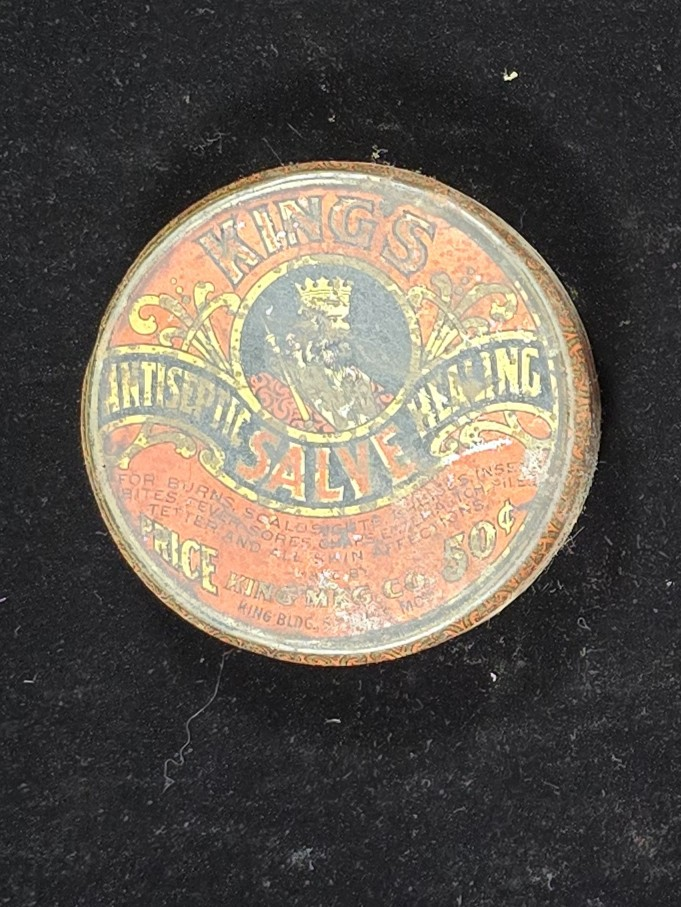
Description
Embossed tin with a crowned king illustration in gold, black, and red. Price marked as 50¢.
This vintage metal tin of King’s Antiseptic Healing Salve was manufactured by the King Manufacturing Company of St. Louis, Missouri. Marketed as a versatile topical remedy, this salve promised relief from a wide range of ailments affecting both humans and livestock. It was sold in a vividly printed round tin adorned with an ornate image of a regal, bearded king wearing a crown.
Contents & Claims
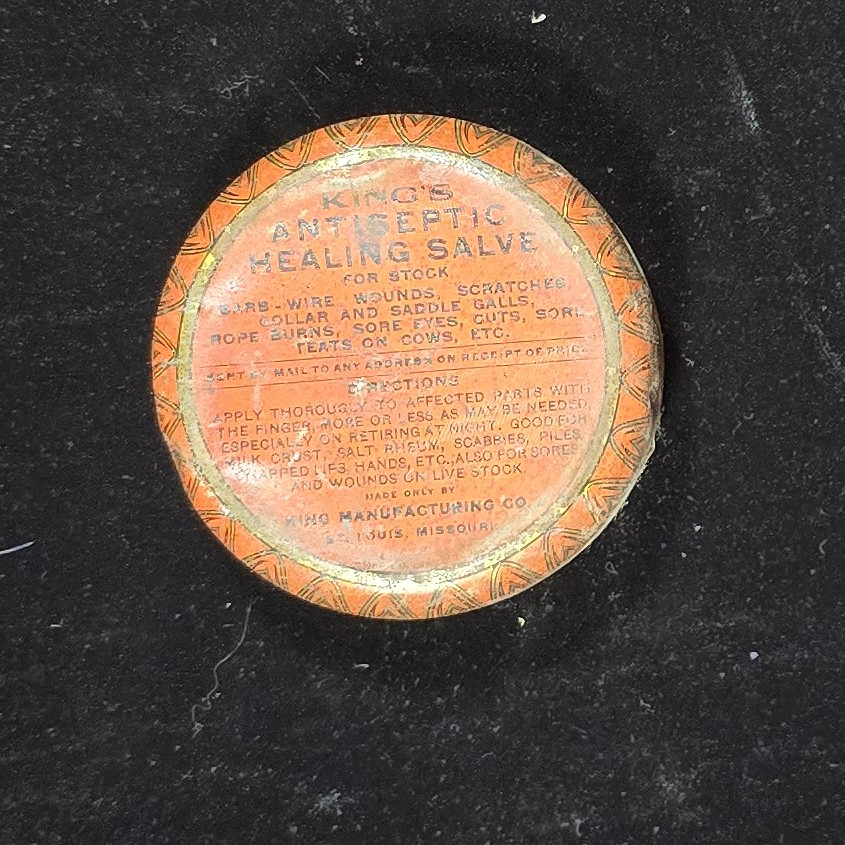
The back of the tin notes it was used for:
Barbed wire wounds, scratches, collar and saddle galls
Rope burns, sore eyes, cuts, sores, teats on cows
Salt rheum, scabbed piles, cracked lips, hands
Wounds on livestock and humans
Directions included:
“Apply thoroughly to affected parts with the finger, more or less as may be needed, especially on retiring at night.”
Condition
Tin is intact with moderate wear and patina
Labels still clearly legible, including therapeutic indications
No visible punctures or leaks; lid remains sealed
Gallery
Historical context
King’s Salve exemplifies the proliferation of antiseptic products following the germ theory revolution in the late 19th century. As understanding of infection control grew, antiseptic ointments like this became household staples. Salves often contained ingredients like phenol, camphor, or even mercury derivatives, though exact composition was rarely disclosed until regulatory changes came with the Pure Food and Drug Act of 1906.
This tin likely dates from the 1910s–1930s, prior to full FDA oversight of therapeutic claims. At that time, such products were sold freely via mail order or general stores across rural America.
Related Reading
Antiseptic – Wikipedia overview of antiseptic history and development
Patent medicine – Background on early 20th-century over-the-counter drug marketing
Curious Facts, Ephemera, and Trivia
The salve claims to help “sore teats on cows,” highlighting the agricultural application of many over-the-counter salves.
50 cents would be equivalent to roughly $8–10 today, making it a premium-priced product for the time.
The regal imagery was likely intended to imply superiority or divine effectiveness—a classic branding trick of the era.
Why it is in the Cabinet
This salve represents the turn-of-the-century boom in multipurpose “cure-all” ointments that were commonly sold over the counter before modern regulation. It’s an excellent example of dual-use veterinary and human medicine, a common practice at the time. The boldly illustrated king logo and wide-ranging indications reflect a fascinating intersection of marketing, medicine, and Americana.
Support Dr. Bebout’s Cabinet of Medical Curiosities
If you enjoy the history, the oddities, and the effort, help keep this cabinet open. Every little bit helps preserve and share the strange wonders of medicine's past.
Buy Me a Ko-fi ☕ Buy Me a Coffee ☕ Tip via PayPal 💵