
Title
J. E. Dooley – Furniture and Undertaker Letterhead
Author
Not applicable — trade stationery from a 19th-century business.
Image
Description
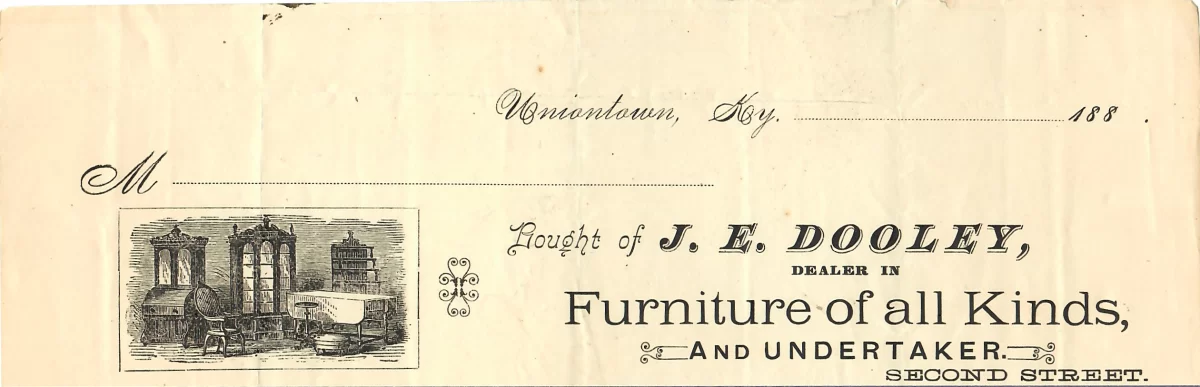
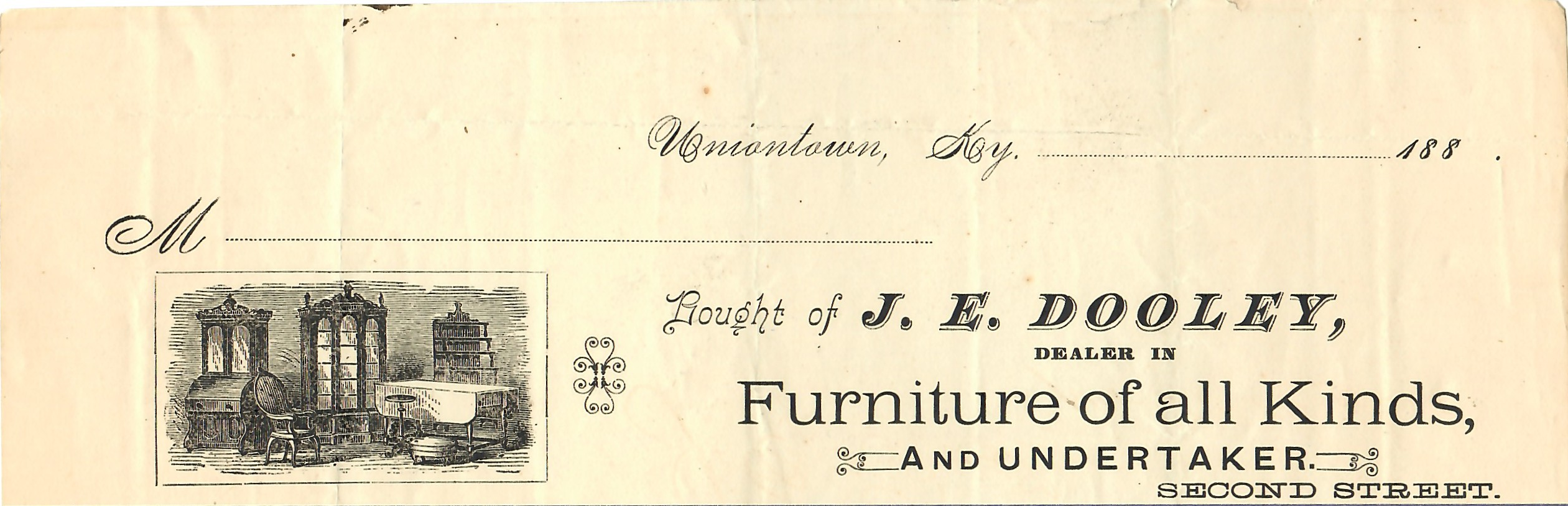
This printed trade letterhead advertises J. E. Dooley, “Dealer in Furniture of All Kinds and Undertaker,” located on Second Street in Uniontown, Kentucky. The engraving depicts a finely furnished Victorian parlor—complete with cabinets, an upholstered chair, and a writing desk—symbolizing both domestic craftsmanship and the funerary trade.
In the 19th century, rural furniture makers often doubled as undertakers, producing coffins alongside household furnishings. Dooley’s business exemplifies this dual profession common throughout small-town Kentucky during the late 1800s. The stationery’s preprinted date line “188__” suggests an issue from the 1880s, when decorative engraved letterheads flourished among tradesmen seeking to convey professionalism and refinement.
Condition
Clean and crisp overall with light toning and minor fold marks; unused with blank ink fields.
Gallery
Historical context
Before funeral homes became distinct institutions, undertakers were typically local craftsmen who supplied furniture, caskets, and burial arrangements. Small businesses like J. E. Dooley’s provided essential domestic and mortuary goods to their communities. The coexistence of “furniture” and “undertaking” on the same letterhead reflects a period when artisanship and death care were intimately linked within the rhythms of small-town life.
Curious Facts, Ephemera, and Trivia
Many 19th-century undertakers used existing woodworking tools to construct coffins, often on short notice after a death in the community. Surviving examples of such dual-purpose letterheads are scarce, as they were typically discarded once used. The engraved parlor image on this piece was a stock illustration commonly sold to printers serving multiple furniture dealers throughout the region.
Excerpt
“Dealer in Furniture of All Kinds and Undertaker — Second Street, Uniontown, Ky.”
This simple line encapsulates a fading era when craftsmanship, commerce, and mortality coexisted on the same shopfront.
Why it is in the Cabinet
This letterhead was preserved for its illustration of the intertwined nature of domestic and funerary trades in 19th-century America. It offers a window into the evolution of the undertaker’s role—from community craftsman to specialized funeral professional—and connects directly to the broader story of medicine, mortality, and material culture represented within the Cabinet of Medical Curiosities.
Support Dr. Bebout’s Cabinet of Medical Curiosities
If you enjoy the history, the oddities, and the effort, help keep this cabinet open. Every little bit helps preserve and share the strange wonders of medicine's past.
Buy Me a Ko-fi ☕ Buy Me a Coffee ☕ Tip via PayPal 💵