Title
Formalin (Formaldehyde Solution) — Schering & Glatz, Inc. (St. Louis / New York)
Author
Manufacturer: Schering & Glatz, Inc.
Image
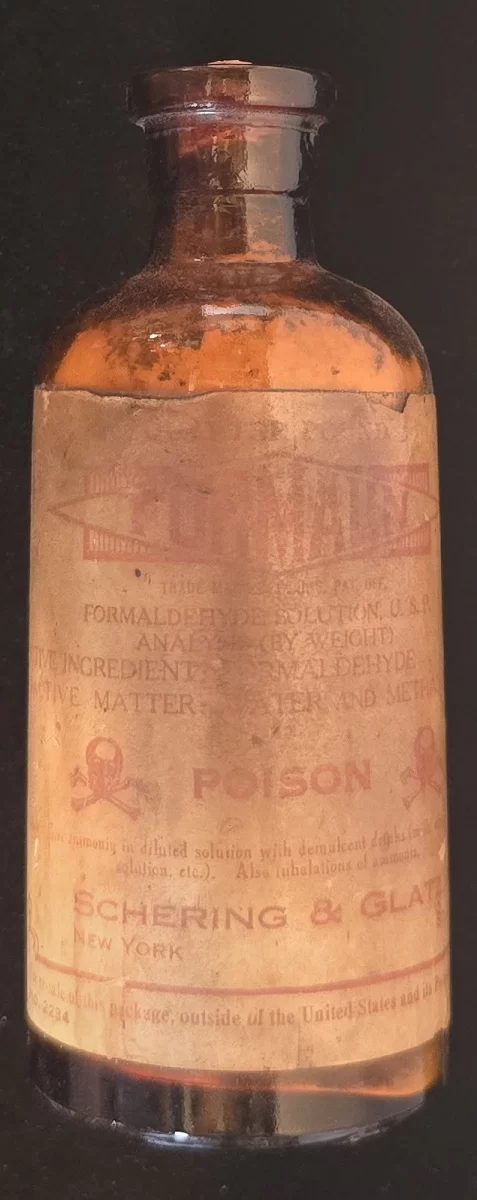
Description
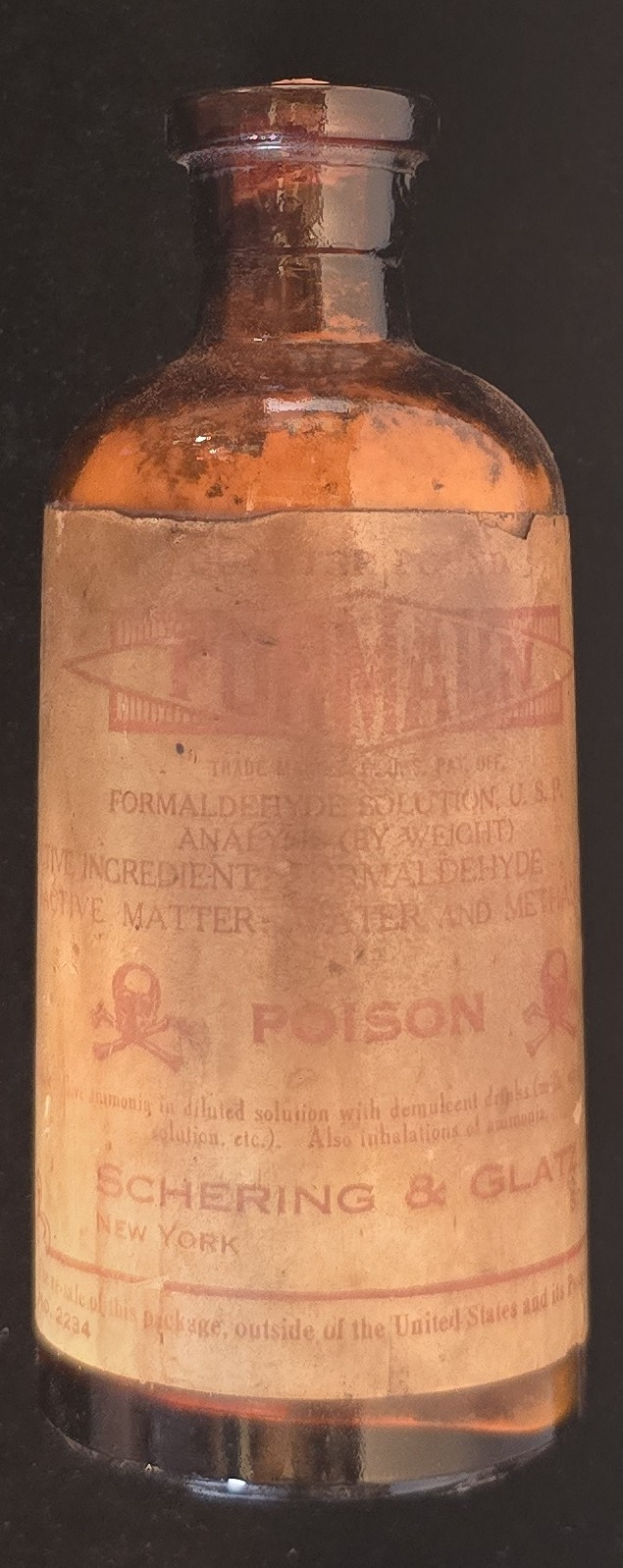
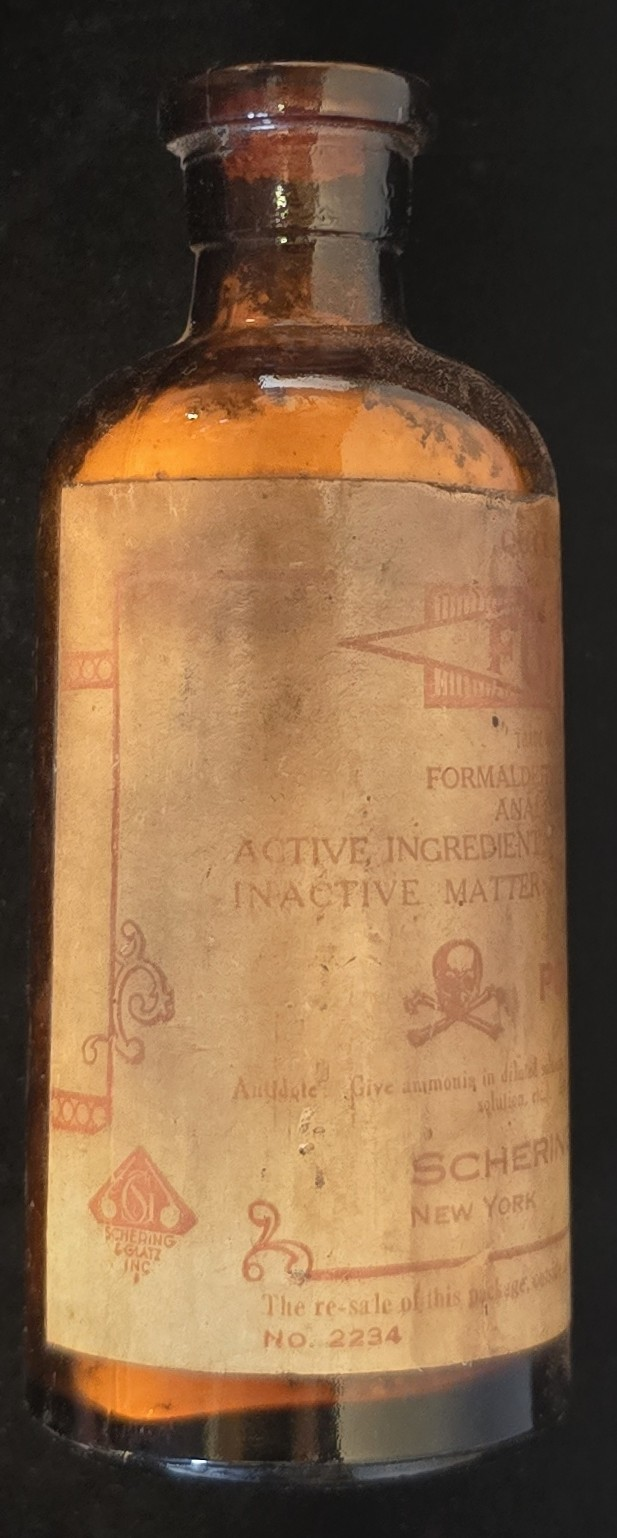
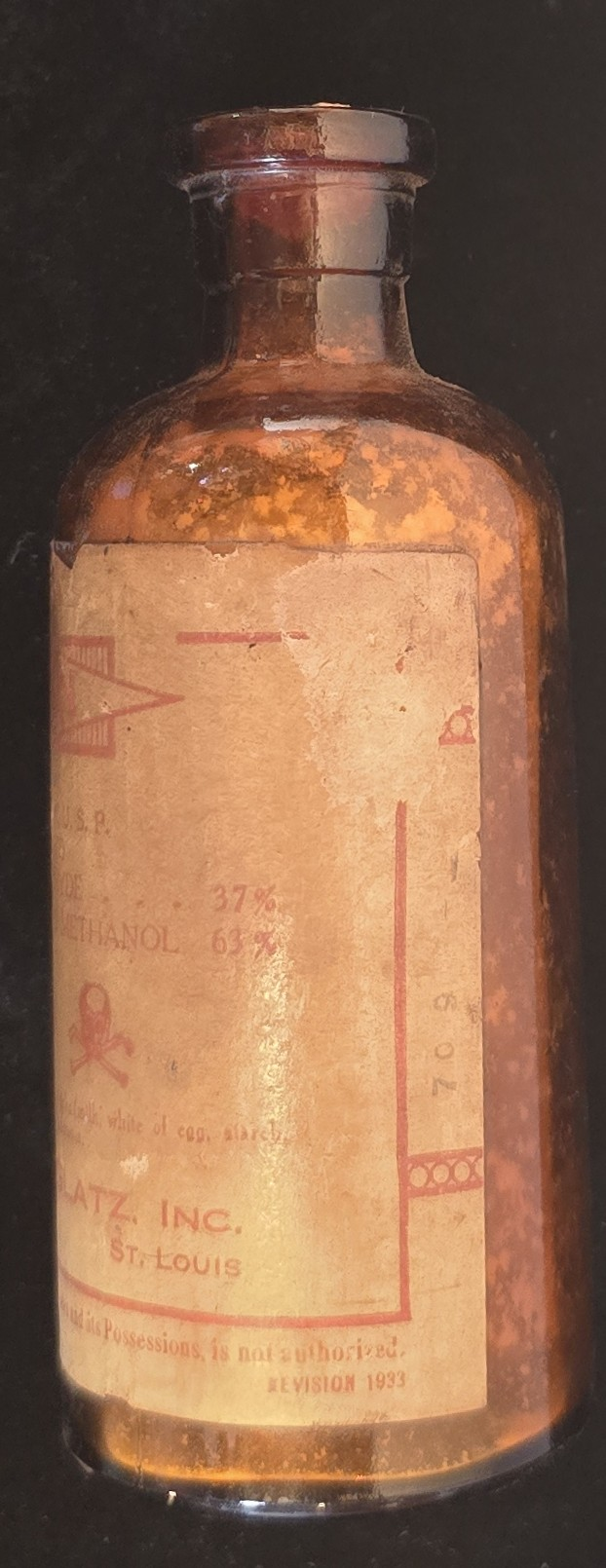
Amber pharmaceutical bottle for Formalin (formaldehyde solution, U.S.P.). Label text (surviving portions) shows typical composition “Formaldehyde 37%” with water and methanol as inactive matter, skull-and-crossbones POISON warning, and company imprint Schering & Glatz, Inc. The label bottom line includes “The re-sale of this package outside of the United States and its Possessions is not authorized. Revision 1933.” Finish is cork-top, machine-made amber glass. Examples represent standard hospital/lab stock disinfectant from the early–mid 20th century.
Condition
Glass intact with strong amber tone. Single original label present, though heavily faded with areas of edge loss and foxing. Red printing (poison emblem, company line, “Revision 1933”) remains partially legible. Interior residue and staining consistent with formalin contents. No chips or cracks observed.
Gallery
Historical context
Formaldehyde was first identified in 1859 and commercialized by the 1890s as a powerful germicide, tissue fixative, and embalming chemical. Its aqueous solution, branded Formalin, became widely adopted in hospitals, schools, and mortuaries. Schering & Glatz, the American arm of the German pharmaceutical company Schering, distributed many potent compounds, including disinfectants and alkaloids. By the 1930s, poison labeling was mandatory, and bottles like this included antidote instructions and distribution restrictions.
Curious Facts, Ephemera, and Trivia
Labels often advised an “antidote: give diluted ammonia with demulcents such as egg white, milk, or starch, and inhalations of ammonia.”
Methanol was listed not as a treatment, but as a stabilizer to keep formaldehyde from crystallizing.
The “not authorized for resale outside the United States” warning reflects trade and patent protections of the era.
Medical schools and labs of the time were filled with the distinctive pungent odor of formalin.
Excerpt
Amber poison bottle of Formalin (formaldehyde solution) from Schering & Glatz, ca. 1930s, complete with skull-and-crossbones and a 1933 revision note on the label.
Why it is in the Cabinet
A striking survival of one of the most widely used — and hazardous — hospital disinfectants. This bottle demonstrates early 20th-century poison labeling practices and the intersection of medicine with industrial chemistry. For a companion essay, see The Ghost of Formalin
Support Dr. Bebout’s Cabinet of Medical Curiosities
If you enjoy the history, the oddities, and the effort, help keep this cabinet open. Every little bit helps preserve and share the strange wonders of medicine's past.
Buy Me a Ko-fi ☕ Buy Me a Coffee ☕ Tip via PayPal 💵