
Title
Diseases of the Foot
Author
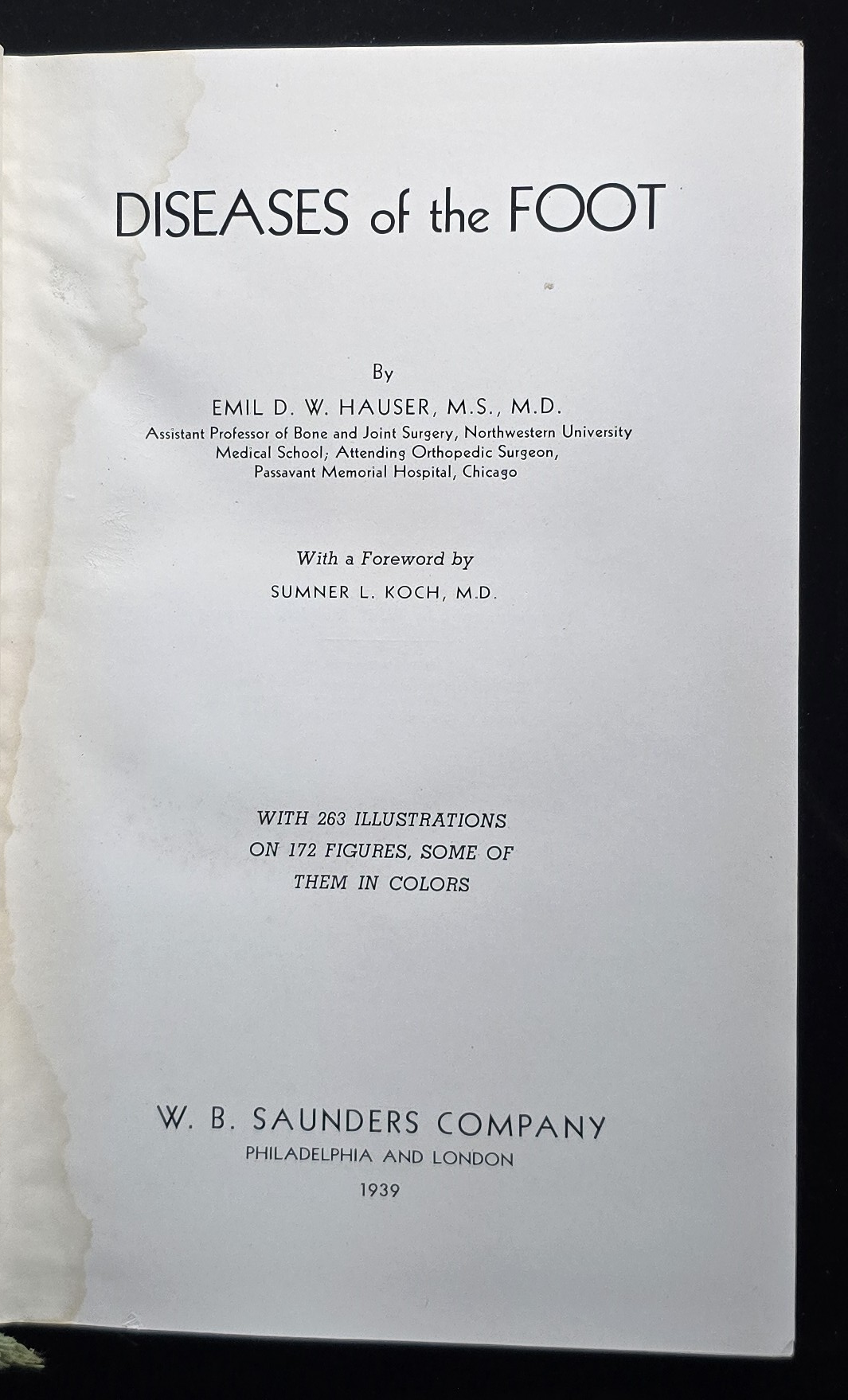
Author: Emil D. W. Hauser, M.S., M.D.
Publisher: W. B. Saunders Company
Publication Year: 1939
Image
Description
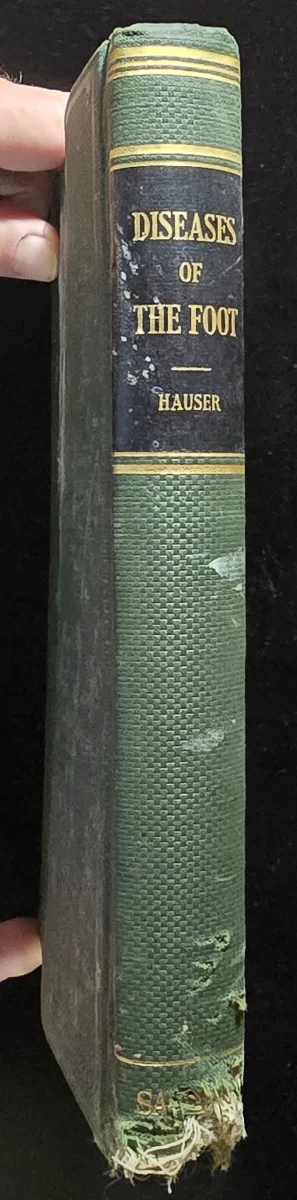
This 1939 medical textbook, Diseases of the Foot, was authored by Emil D. W. Hauser, M.S., M.D., Assistant Professor of Bone and Joint Surgery at Northwestern University Medical School and Attending Orthopedic Surgeon at Passavant Memorial Hospital in Chicago. With a foreword by Sumner L. Koch, M.D., the book includes 263 illustrations across 172 figures, some in color, to assist in the diagnosis and treatment of foot disorders.
Topics covered range from structural deformities like pes valgoplanus and hallux valgus, to surgical corrections, infections, trauma, and orthopedic conditions specific to the forefoot and hindfoot. The book provides a comprehensive look at pre-antibiotic-era surgical management, including techniques involving osteotomes, Stille bone forceps, and detailed approaches to soft tissue handling.
Condition
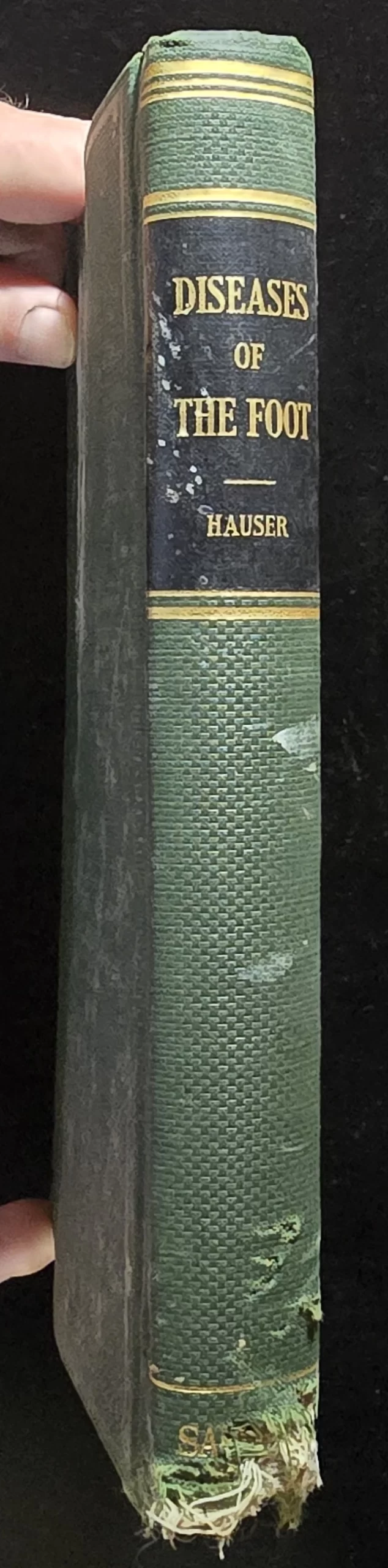
Cover: Green cloth hardcover with moderate edge wear and heavy fraying at the tail of the spine
Spine: Legible gilt title over black label; structurally intact
Pages: Complete with water staining along the upper and outer margins of multiple pages, especially toward the front matter; all text remains legible
Binding: Sound, with some looseness
Illustrations: Black-and-white clinical photographs and diagrams intact and well-preserved
Gallery


Historical context
Published on the eve of World War II, this book reflects pre-antibiotic orthopedic practice—before the widespread use of penicillin or modern internal fixation devices. The emphasis is on surgical technique, physical deformity correction, and biomechanical evaluation based on observation and manual treatment.
The W. B. Saunders Company was a leading publisher of clinical texts during the early 20th century, and this title would have served as a standard orthopedic reference for physicians treating everything from congenital deformities to post-traumatic foot injuries in both civilian and military contexts.
Dr. Hauser’s academic affiliation with Northwestern University and his hospital work at Passavant Memorial place this work in the academic tradition of Midwestern surgical expertise.
Curious Facts, Ephemera, and Trivia
The included surgical instructions reference Stille bone-cutting forceps and osteotomes, showcasing tools that remain recognizable in modern orthopedic sets today.
The book’s claim of “263 illustrations on 172 figures” demonstrates the heavy emphasis on visual anatomy and deformity correction, a priority in podiatric and orthopedic education.
Despite the technical nature, the chapter on “Technic” uses clear, direct prose—highlighting an era when surgical texts were written for practicing physicians, not just academic audiences.
Some color plates (not shown here) include cross-sectional illustrations of soft tissue structures in the foot and ankle.
Diseases of the Foot predates the establishment of podiatric medicine as a distinct medical specialty, making it a bridge between general orthopedics and the later formalization of foot-specific care.
Excerpt
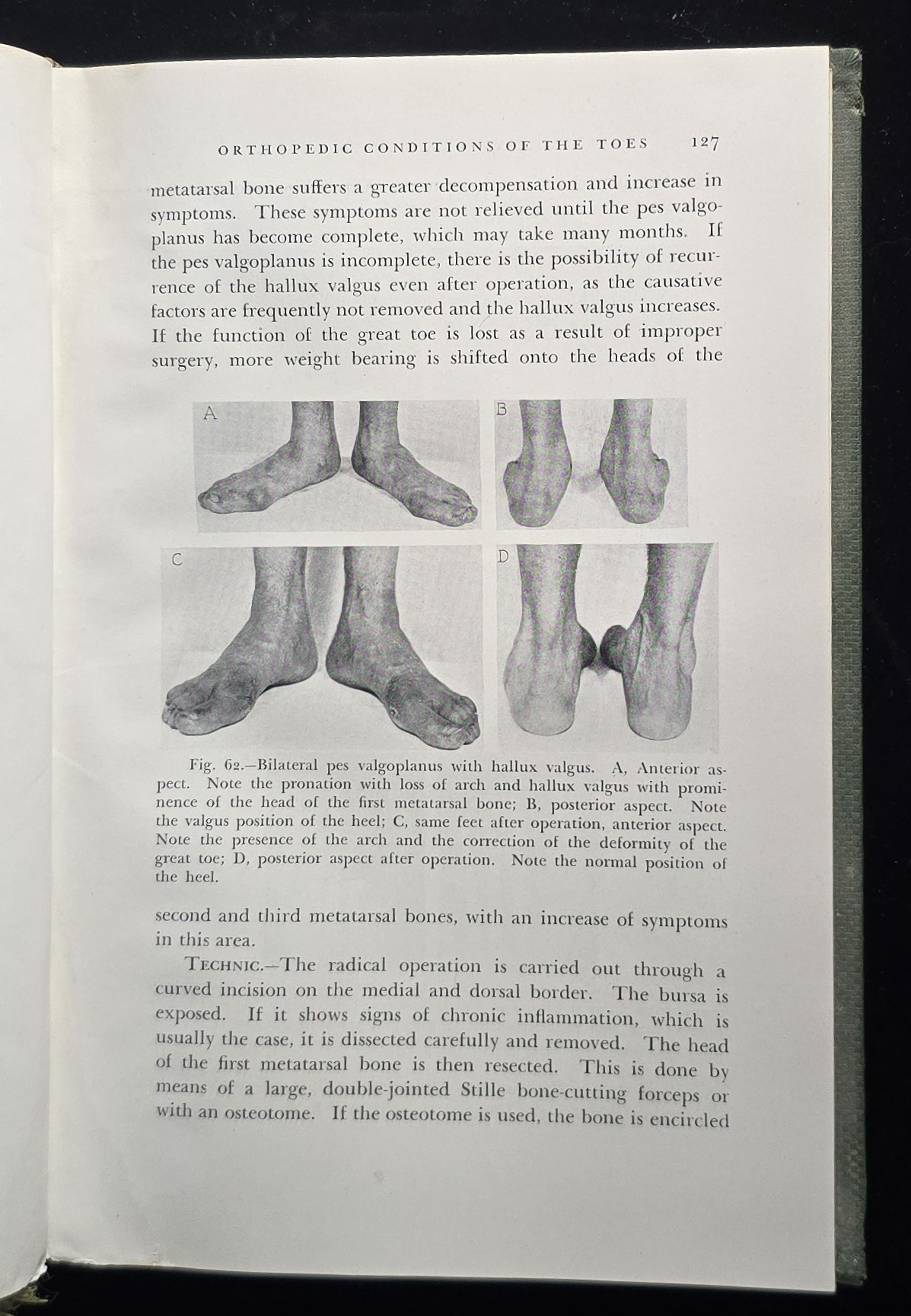
From p. 127, on hallux valgus and pes valgoplanus:
“Note the pronation with loss of arch and hallux valgus with prominence of the head of the first metatarsal bone… Note the presence of the arch and the correction of the deformity of the great toe… The radical operation is carried out through a curved incision on the medial and dorsal border… This is done by means of a large, double-jointed Stille bone-cutting forceps or with an osteotome.”
Why it is in the Cabinet
This book is a time capsule of orthopedic surgery before modern imaging, antibiotics, or prosthetics. It offers rare insight into how physicians approached chronic deformities with manual tools, surgical skill, and detailed anatomical understanding. Its extensive illustrations and mid-century academic pedigree mark it as a foundational orthopedic text.
Despite the heavy water staining and worn exterior, this copy survived decades of handling and likely saw use in clinical or educational settings—perhaps passed through the hands of surgeons-in-training or wartime physicians.
Its presence in the Cabinet honors the evolution of surgical care, the craftsmanship of early clinical publishing, and the practical realities of healing feet before the luxury of modern support devices.
Support Dr. Bebout’s Cabinet of Medical Curiosities
If you enjoy the history, the oddities, and the effort, help keep this cabinet open. Every little bit helps preserve and share the strange wonders of medicine's past.
Buy Me a Ko-fi ☕ Buy Me a Coffee ☕ Tip via PayPal 💵