
Aristol Prescription for E. G. Laas – Drs. Pier & Tottenham, Brenham, Texas
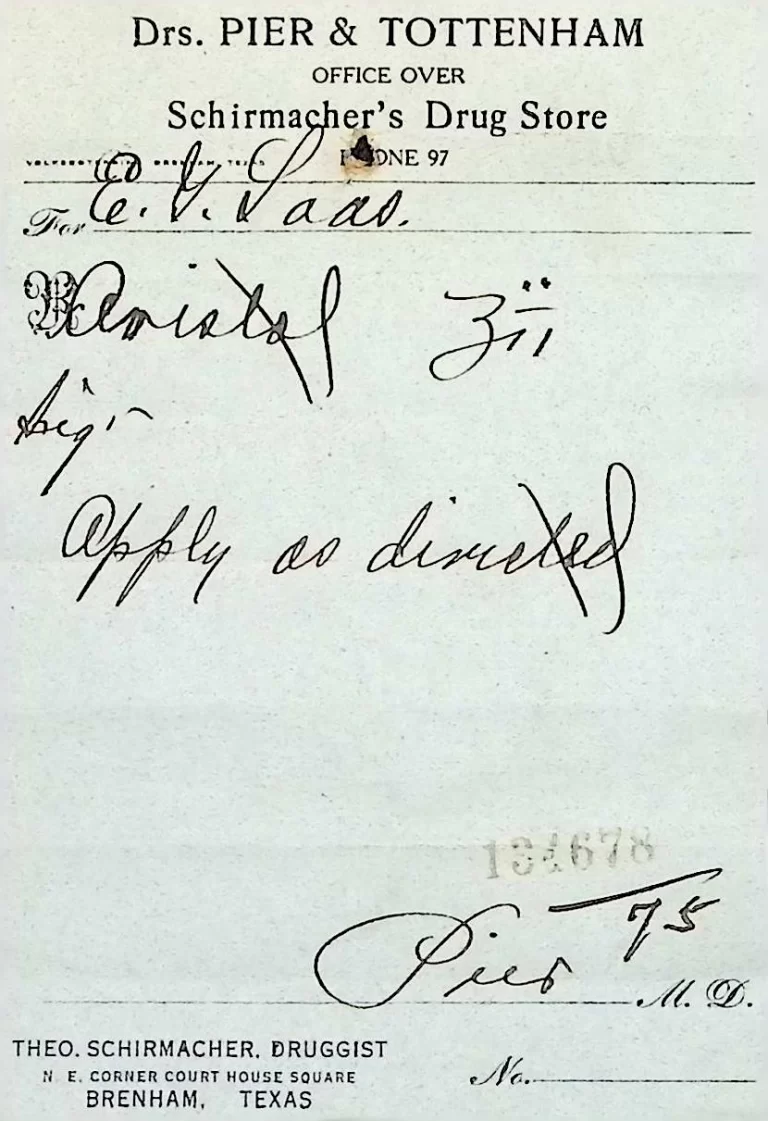
Prescribing Doctor: Dr. Pier
Patient Name: E. G. Laas
Pharmacy: Schirmacher’s Drug Store
Date: Undated (Estimated 1895–1910)
Location: Brenham, Texas
Transcription
℞
Aristol ʒii
Sig: Apply as directed
Interpretation
This prescription directs the use of 2 drams of Aristol, a once-popular antiseptic compound, to be applied as directed. Aristol, or di-thymol-iodide, was commonly used for skin infections, wounds, and ulcers prior to the widespread use of antibiotics.
Condition
Paper is well-preserved with sharp type and clear black ink handwriting. A small hole at the top may be from a tack or staple. The stamp number “134678” remains visible. Pharmacy imprint includes both doctor’s office and druggist information, showing strong vertical integration in the practice.
Historical Context
Aristol was developed in the 1890s as a less odorous alternative to iodoform and was marketed as a wound dressing, antiseptic, and topical treatment. It fell out of favor by mid-20th century due to the rise of sulfa drugs and antibiotics. Prescriptions like this highlight the era’s reliance on chemically derived antiseptics for outpatient wound care.
Curious Facts and Trivia
Aristol was a trade name; its generic name is thymol iodide.
It was widely used for tuberculosis ulcers, surgical dressings, and even in some gynecologic applications.
The location—Brenham, Texas—was a developing town at the time, and the dual listing of “Drs. Pier & Tottenham” above a local pharmacy reflects the tight-knit nature of rural healthcare.
Callout Box
⚠️ Caution: Aristol contains iodine, which can cause sensitivity reactions in some individuals. Though not systemically toxic like mercury or arsenic compounds, its use has been discontinued in modern medicine.
Why It’s in the Cabinet
This prescription preserves a glimpse of early 20th-century dermatologic and antiseptic practice—an era before antibiotics, when surface wounds were treated with chemical powders and tinctures. It also showcases small-town pharmacy-doctor collaborations in the American South.
Support Dr. Bebout’s Cabinet of Medical Curiosities
If you enjoy the history, the oddities, and the effort, help keep this cabinet open. Every little bit helps preserve and share the strange wonders of medicine's past.
Buy Me a Ko-fi ☕ Buy Me a Coffee ☕ Tip via PayPal 💵