
Prescription Archives Entry: Argyrol for Julin Armstrong
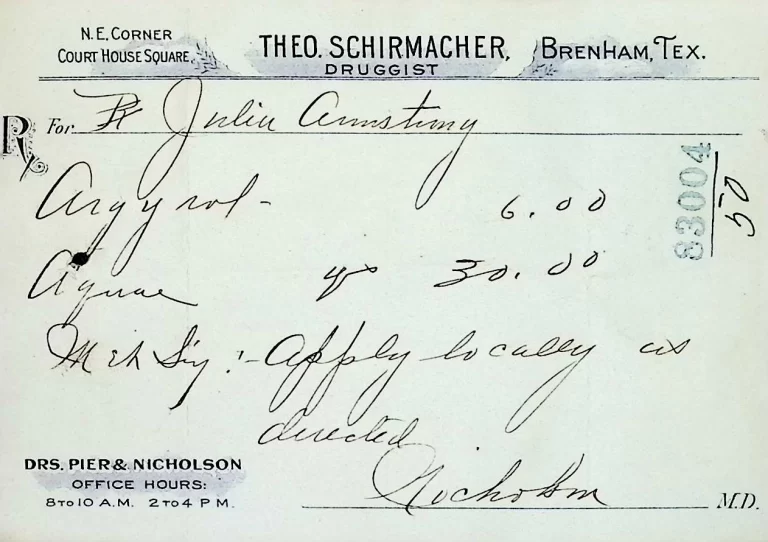
Patient: Julia Armstrong
Prescribing Physician: Dr. Nicholson
Pharmacy: Theo. Schirmacher, Druggist, Brenham, Texas
Date: Not specified (circa early 1900s)
Transcription
℞
Argyrol 6.00
Aqua 4 [unclear] 30.00
M. Sig: Apply locally as directed.Nicholson
Interpretation
This prescription combines Argyrol, a silver-based antiseptic, with aqua (water) to create a topical solution intended for local application. The notations “6.00” and “30.00” may represent quantities in mL or pricing, though the exact units are not confirmed. The phrase following “Aqua” is illegible, but could indicate either a measurement or preparation instruction.
The medication was likely dispensed as a solution to be applied directly to the affected area. While the specific condition isn’t noted, this type of preparation was commonly used for eye infections, mucosal inflammation, and nasopharyngeal disorders.
Condition
Prescription slip is in excellent condition with clear ink and minimal discoloration. The stamp number is visible, and most of the handwriting is legible, though one line is unclear.
Historical Context
Argyrol was invented in 1901 by Albert C. Barnes (of Barnes Foundation fame). It became a staple in early 20th-century medicine, particularly for preventing gonorrheal ophthalmia in newborns. Though marketed heavily for its antiseptic properties, it fell out of favor due to risks of argyria (skin discoloration from silver buildup), and because more effective antibiotics emerged by the mid-20th century.
This prescription offers a glimpse into a time when silver compounds were at the forefront of antimicrobial therapy.
Curious Facts and Trivia
Argyrol was once so widely used that traveling medicine shows and early 20th-century catalogs sold it over-the-counter.
Albert C. Barnes, who created Argyrol, made a fortune from it and used the proceeds to amass one of the most important art collections in the U.S.
Argyrol was promoted as safe for infants, despite the known risk of permanent skin staining from silver buildup.
Some early 1900s practitioners prescribed Argyrol as a nasal spray, ear drop, or eye wash—multipurpose, but not always wisely used.
Callout Box
⚠️ Caution: The Risk of Argyria – While silver-based medicines like Argyrol were once praised as miracle antiseptics, they came with a serious drawback: argyria. This condition causes the skin to turn a permanent blue-gray due to silver particle accumulation in the body. Though rare, it is irreversible and became a driving factor in Argyrol’s decline. The risk was especially high with chronic or excessive use.
Today, silver is still used medically (in wound dressings and catheters), but under tightly controlled conditions.
Why It’s in the Cabinet
This prescription captures the era when silver-based treatments were medical mainstays. Argyrol in particular was a pharmacy shelf essential, prescribed across a wide range of conditions. It’s a beautiful example of the transition from chemical-era antiseptics to the dawn of modern antibiotics.
Support Dr. Bebout’s Cabinet of Medical Curiosities
If you enjoy the history, the oddities, and the effort, help keep this cabinet open. Every little bit helps preserve and share the strange wonders of medicine's past.
Buy Me a Ko-fi ☕ Buy Me a Coffee ☕ Tip via PayPal 💵