
Vintage Baby Powder
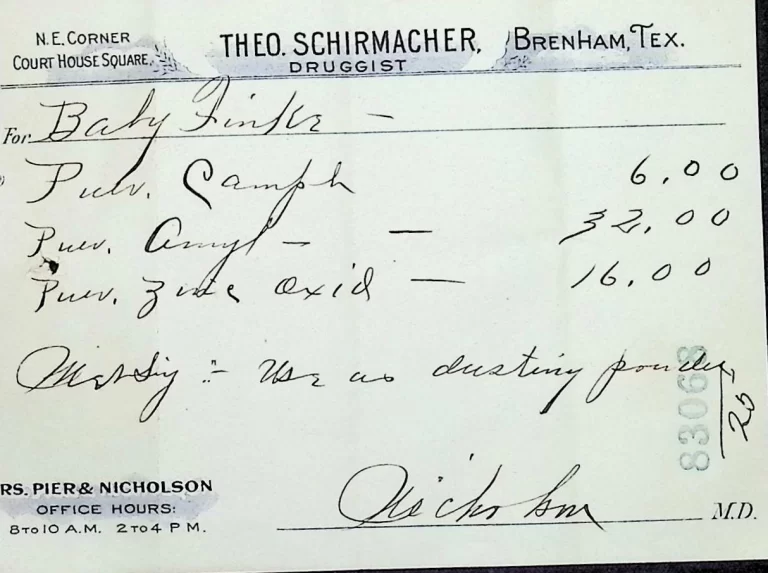
Prescribing Doctor: Dr. Nicholson
Patient Name: Baby Finke
Pharmacy: Theo. Schirmacher, Druggist
Date: Undated (estimated 1900–1910)
Location: Brenham, Texas
Transcription
℞
Pulv. Camph. — 6 parts
Pulv. Amyl. (powdered starch) — 32 parts
Pulv. Zinc Oxidi (zinc oxide) — 16 parts
Mix and Sig.: Use as dusting powder.
Interpretation
This prescription was written for Baby Finke and compounded by a local druggist in Brenham, Texas. The formula combines:
Camphor → cooling and mildly antiseptic.
Starch (Amylum) → moisture-absorbing base.
Zinc oxide → skin protectant, soothing for irritation.
Together, these created an early version of baby powder.
Condition
The paper is intact with minimal staining, bearing the printed letterhead of Theo. Schirmacher, Druggist, Brenham, Tex. Ink remains legible, with the physician’s bold signature visible at the bottom.
Historical Context
Before Johnson’s Baby Powder became a household staple, parents often relied on custom-compounded dusting powders from their pharmacist to protect infants from rash and irritation. Dusting powders like this one were made fresh from simple ingredients like starch and zinc oxide. Only later did companies such as Johnson & Johnson introduce pre-packaged baby powders that became household staples.
Curious Facts and Trivia
Johnson & Johnson first marketed baby powder in 1894 — one year after a company employee suggested adding a small tin of talc to soothe skin irritation caused by medicated plasters. Early tins sold for 15 cents. This prescription predates that commercial success, showing that parents were already using dusting powders long before the iconic tins appeared.
Callout Box
⚠ Caution: While zinc oxide and starch remain safe skin protectants, camphor is no longer used in baby powders due to toxicity if swallowed or absorbed in high amounts. Historical remedies often combined otherwise harmless bases with ingredients now considered unsafe for infants.
Why It’s in the Cabinet
This prescription illustrates the evolution of baby care: from customized, pharmacist-made remedies to mass-marketed consumer products. As a forerunner to Johnson’s Baby Powder, it represents both the ingenuity of early pharmacists and the changing face of everyday medicine.
Support Dr. Bebout’s Cabinet of Medical Curiosities
If you enjoy the history, the oddities, and the effort, help keep this cabinet open. Every little bit helps preserve and share the strange wonders of medicine's past.
Buy Me a Ko-fi ☕ Buy Me a Coffee ☕ Tip via PayPal 💵