
Title
Hunt’s Remedy – The Great Kidney & Liver Medicine
Author
William E. Clarke, Proprietor, Providence, Rhode Island
Image
Description
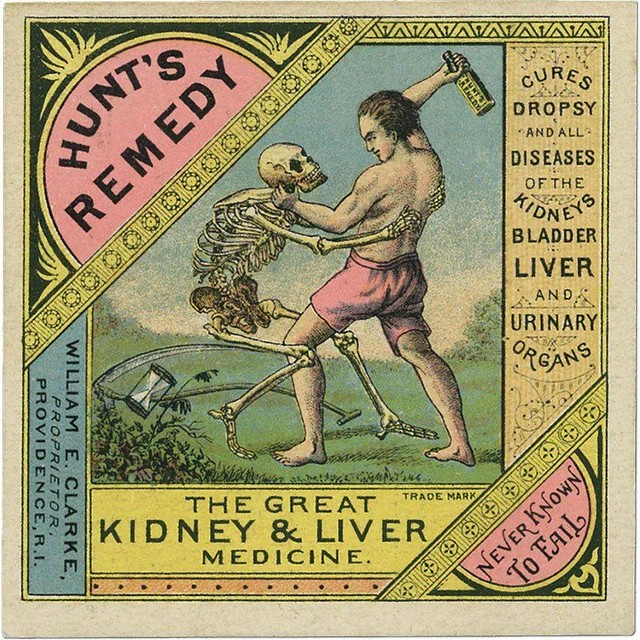
This vivid late-19th century trade card for Hunt’s Remedy depicts a muscular man grappling with a skeletal representation of Death, bottle in hand, symbolizing the medicine’s promise to “defeat” fatal diseases. Advertised as curing dropsy (edema) and “all diseases of the kidneys, bladder, liver, and urinary organs,” Hunt’s Remedy was marketed as a powerful but safe cure-all in an era before modern drug regulation. The dramatic imagery and bold health claims reflect the competitive world of patent medicines, where visual impact and persuasive language were as important as the formula itself.
Condition
Excellent preserved color lithograph trade card. Minimal corner wear. Printing remains bright and legible.
Historical context
Hunt’s Remedy originated in the mid-to-late 1800s, a period when kidney and bladder ailments were poorly understood and often fatal. “Dropsy” was a general term for fluid retention, often a symptom of heart, liver, or kidney failure. Medicines like Hunt’s Remedy promised miraculous recovery, though many contained herbal diuretics and alcohol as primary active ingredients. The proprietor, William E. Clarke of Providence, R.I., used aggressive advertising, including vivid allegorical artwork, to stand out in the crowded patent medicine market.
Curious Facts, Ephemera, and Trivia
“Never Known to Fail” was a common 19th-century advertising boast, intended to reassure skeptical buyers.
Many Hunt’s Remedy ads claimed it could restore health in cases doctors had declared hopeless.
Surviving bottles and trade cards are collectible examples of patent medicine marketing art.
Excerpt
“Cures dropsy and all diseases of the kidneys, bladder, liver, and urinary organs. Never known to fail.”
Why it is in the Cabinet
This trade card is a striking example of how late-Victorian patent medicine companies used fear and hope in equal measure to sell their products. Its dramatic imagery makes it an essential piece of medical advertising history.
Support Dr. Bebout’s Cabinet of Medical Curiosities
If you enjoy the history, the oddities, and the effort, help keep this cabinet open. Every little bit helps preserve and share the strange wonders of medicine's past.
Buy Me a Ko-fi ☕ Buy Me a Coffee ☕ Tip via PayPal 💵