
Title
Milkinol Constipation Remedy Bottle
Author
Maker: Kremers-Urban Company
Location: Milwaukee, Wisconsin
Image
Description
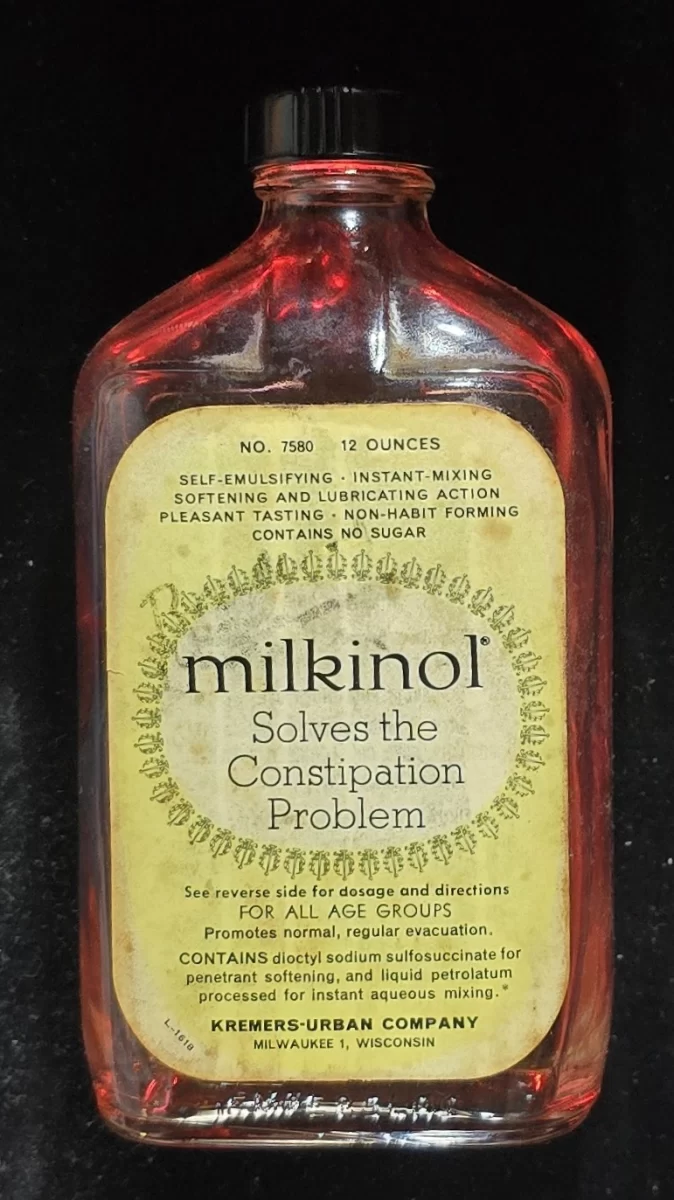
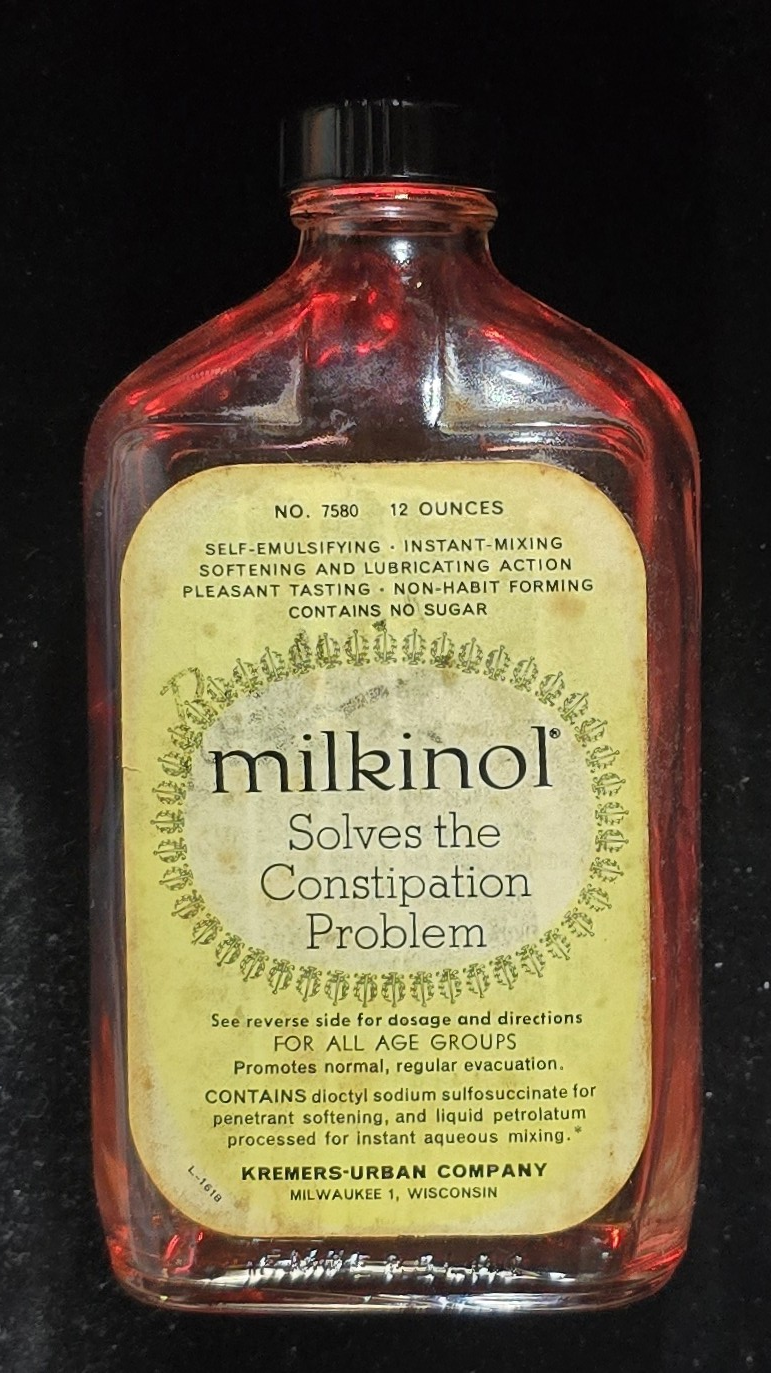
Flat-sided clear glass bottle with bold, cream-colored label. Milkinol was marketed as a pleasant-tasting, self-emulsifying laxative suitable for “all age groups.” The front label highlights its non-habit-forming nature, sugar-free formula, and “instant mixing” properties.
The active ingredients include:
Dioctyl sodium sulfosuccinate (a modern stool softener)
Liquid petrolatum (mineral oil)
Milkinol was intended to be mixed with water or juice and taken at bedtime to promote regular bowel movements. This 12-ounce bottle was manufactured by Kremers-Urban Company of Milwaukee, Wisconsin — a major pharmaceutical supplier to American drugstores and hospitals in the mid-20th century.
Condition
Glass: Excellent with no chips or cracks
Cap: Original black plastic screw-on cap intact
Label (front): Fully legible with slight aging and toning
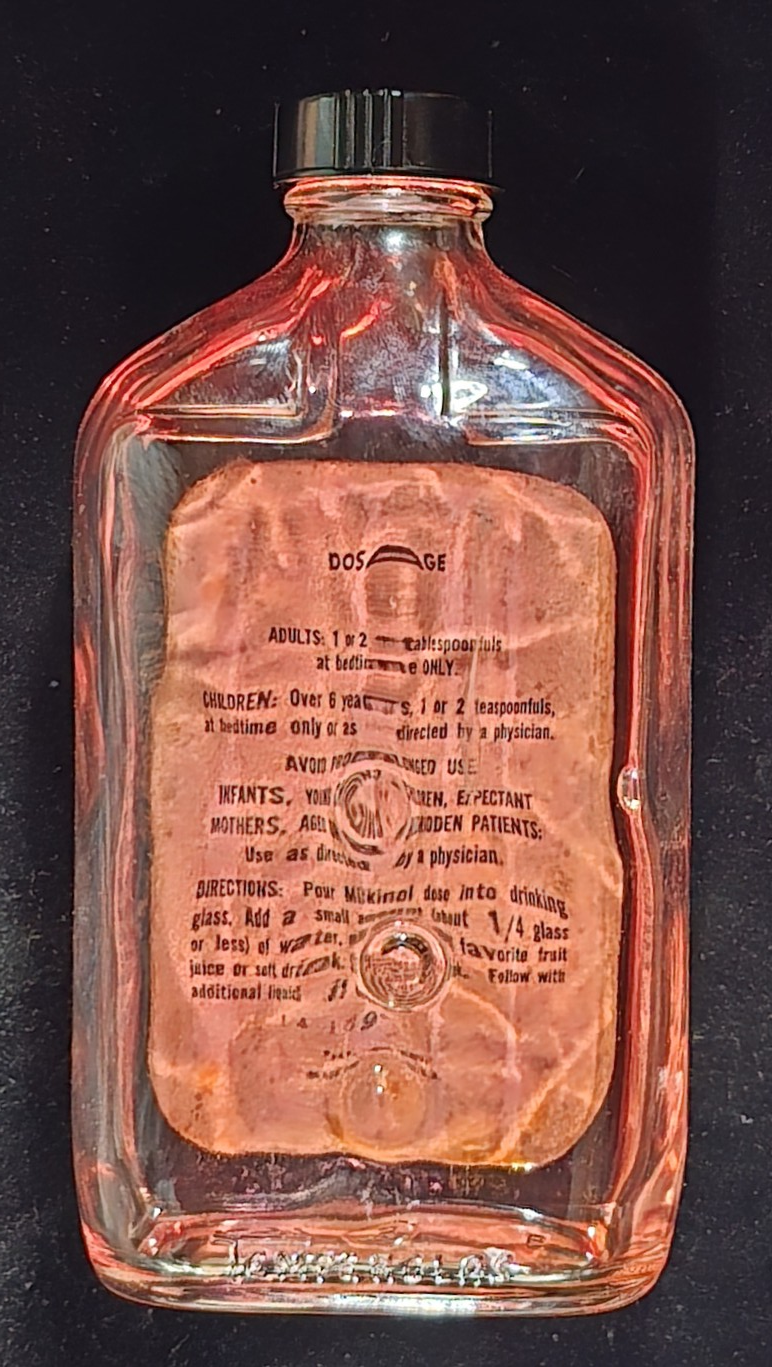
Label (back): Some fading and water damage; dosage instructions remain mostly readable
Contents: Empty, with light residue visible
Gallery
Historical context
Milkinol reflects the post–patent medicine era shift toward scientifically framed, over-the-counter treatments. By the 1950s, the laxative market had moved away from castor oil and herbal purgatives toward chemical softeners like docusate and lubricants like mineral oil.
Kremers-Urban, founded in the 1870s, was known for producing both ethical drugs and generics. Milkinol was designed to soothe consumer anxiety about “habit-forming” medications, emphasizing gentle action, palatability, and ease of use.
The use of terms like self-emulsifying and non-habit forming shows how pharmaceuticals were beginning to adopt technical language as marketing — part of the rise of scientific consumerism in mid-century American healthcare.
Curious Facts, Ephemera, and Trivia
Dioctyl sodium sulfosuccinate is still used today in over-the-counter stool softeners like Colace.
The product was advertised as safe for infants, children, expectant mothers, and the elderly — a claim that would raise regulatory concerns today.
The label offers guidance for mixing Milkinol with fruit juice or soda, suggesting the taste may not have lived up to the “pleasant” claim.
This bottle represents a transitional moment between apothecary-style tonics and modern clinical packaging — flat, labeled, sealed, and measured.
Kremers-Urban was acquired by Schwarz Pharma in 2005 and eventually became part of UCB and Lannett.
Excerpt
Milkinol® — Solves the Constipation Problem
Self-emulsifying · Instant mixing · Softening and lubricating action
Pleasant tasting · Non-habit forming · Contains no sugar
FOR ALL AGE GROUPS — Promotes normal, regular evacuation.
Contains dioctyl sodium sulfosuccinate for softening, and liquid petrolatum processed for instant aqueous mixing.
Why it is in the Cabinet
This bottle represents a mid-century American approach to gastrointestinal health — hygienic, pleasant, and engineered for broad use. It illustrates the shift from purgative “cure-all” tonics to scientifically measured, targeted remedies. Its branding, flat bottle shape, and reassuring claims show how 20th-century medicine learned to sell not just relief, but comfort and control.
Milkinol belongs in the Cabinet as a snapshot of the modern pharmaceutical age in its infancy, when science became a selling point and laxatives became lifestyle-friendly.
Support Dr. Bebout’s Cabinet of Medical Curiosities
If you enjoy the history, the oddities, and the effort, help keep this cabinet open. Every little bit helps preserve and share the strange wonders of medicine's past.
Buy Me a Ko-fi ☕ Buy Me a Coffee ☕ Tip via PayPal 💵