
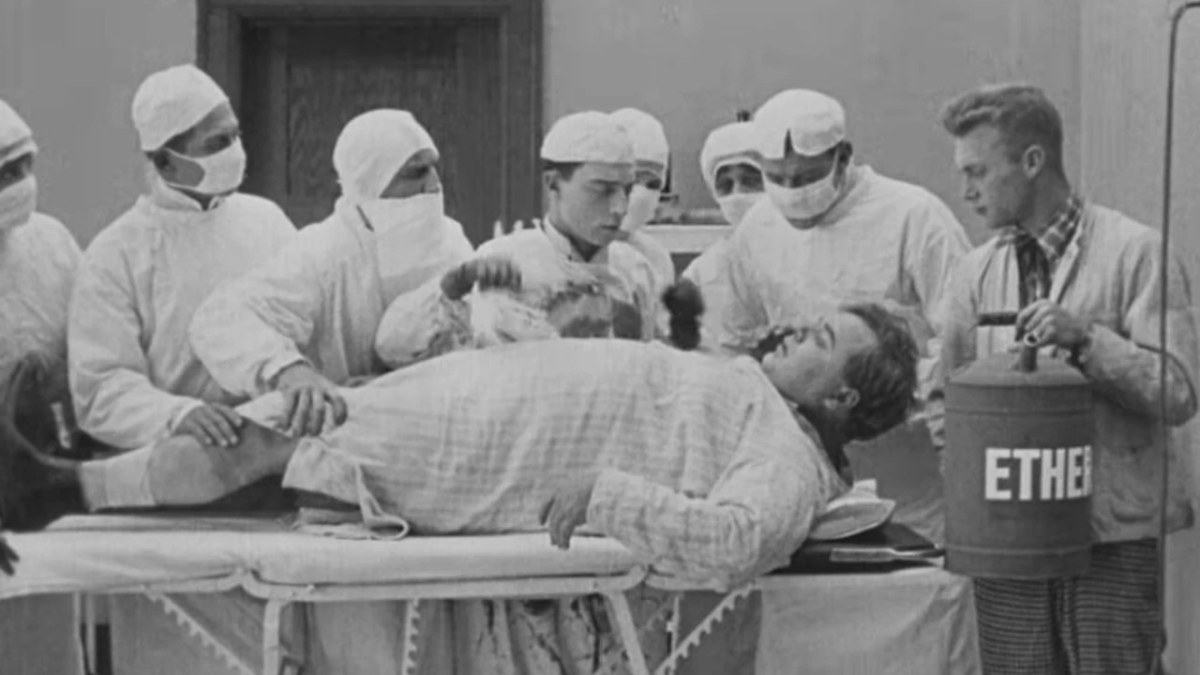
Hollywood Needs a Medical Consultant. I Volunteer.
I’ve thought for years that Hollywood ought to hire me as a medical consultant. Not because I have any particular desire to work in Hollywood, but because somebody needs to tell these people how badly they screw up medical scenes.
I’ve practiced medicine for over thirty years, including about fifteen years in emergency medicine, and I can’t seem to watch a medical scene in a movie or television show without shaking my head, laughing, or occasionally yelling at the screen.
Some of the mistakes are so ridiculous that I wonder whether anyone involved in making the show bothered to ask a medical professional how things actually work.
One of the earliest examples I remember was from a television show I watched years ago. I can’t remember the name of the show, but I’ve never forgotten the scene.
A patient was lying in an intensive care unit, apparently on life support. Behind the bed was a ventilator with its bellows visibly cycling up and down. Everything looked appropriately serious and dramatic.
Then the camera panned over to the patient.
He wasn’t intubated. He didn’t have a tracheostomy. He was lying there with a nasal cannula in his nose.
What the hell was that ventilator ventilating? The room?
I realize most people watching probably wouldn’t notice something like that. But I certainly did, and I remember laughing at how absurd it was.
Then there’s James Bond.
In Die Another Day, Pierce Brosnan’s Bond finds himself in a medical clinic where a North Korean operative is undergoing procedures to completely change his appearance.
The man is lying in a hospital bed with an IV running when Bond decides to interrogate him. Apparently, Bond has discovered a revolutionary new method of torture.
He grabs the IV bag and squeezes it.
The patient immediately sits up in agony, groaning and writhing. Bond squeezes the bag again, and the poor fellow suffers another wave of excruciating pain.
I remember thinking, “What the hell is he doing to him?”
He’s squeezing an IV bag. Unless there’s something particularly nasty in that bag, all he’s doing is making the fluid run a little faster. It’s not exactly an effective interrogation technique.
But the guy certainly seemed convinced.
Another one that has stuck with me came from Doogie Howser, M.D.
I once watched young Doogie receive a patient in the emergency department with a chest injury. He examined the patient, figured out what was wrong, inserted a chest tube, stabilized him, and had him transferred to the intensive care unit in what appeared to be about five or ten minutes.
Now, that’s impressive.
Not the medical care. The efficiency.
I’ve spent enough time in emergency departments to know that you can sometimes perform the lifesaving procedure faster than you can get everything else arranged.
Doogie managed the entire affair in less time than it sometimes takes to find somebody who knows where the chest tube tray is.
And then there’s Kill Bill.
Uma Thurman’s character has been shot in the head and spent years in a coma. When she finally wakes up, she discovers that she can’t move her legs.
Well, that’s not particularly surprising.
What happens next certainly is.
Through sheer determination, she manages to rehabilitate herself over the course of an afternoon. A little concentration, some toe wiggling, and before long she’s back in business.
Never mind the years of immobility. Never mind the muscle atrophy, contractures, weakness, and prolonged rehabilitation that would normally accompany that kind of situation.
Apparently, she’d just been taking a particularly long nap.
I know Kill Bill isn’t supposed to be a medical documentary. I don’t expect Quentin Tarantino to give me a detailed explanation of the consequences of prolonged immobilization. But Jesus Christ, the woman had supposedly been lying in a bed for years.
Recently, I discovered that I’m not the only person who has this problem.
I’m currently reading A Is for Arsenic: The Poisons of Agatha Christie by Kathryn Harkup. It’s a fascinating book that examines the poisons Christie used in her mysteries, how they affect the human body, and how accurately she portrayed their effects.
While discussing arsenic, Harkup made a comment that nearly caused me to spit out my drink. She admitted that she sometimes catches herself yelling at the television or movie screen when somebody gets the science of poisoning completely wrong.
I immediately recognized a kindred spirit.
Her particular complaint was the Hollywood tendency to have somebody swallow poison, grab their throat, gag dramatically, and fall over dead within seconds.
And she’s right. That’s not how most poisons work.
Different poisons have different mechanisms of action. Some produce symptoms rapidly, while others take hours or even days. Some cause neurological symptoms, others affect the heart, liver, kidneys, or gastrointestinal tract.
Unfortunately, watching somebody gradually develop abdominal cramps, vomiting, and diarrhea doesn’t make for particularly exciting television.
I understand that movies and television shows have to take liberties with reality. Nobody wants to watch a two-hour movie about waiting for laboratory results, arguing with an insurance company, or trying to find an available ICU bed.
I’ve done enough of that in real life.
But there’s a difference between taking a few liberties for the sake of entertainment and getting something so completely wrong that it becomes laughable.
And what irritates me most is how easily some of these mistakes could have been avoided.
Hollywood spends millions of dollars on costumes, sets, special effects, and historical details. They’ll hire experts to make sure somebody is holding the correct firearm or driving the appropriate automobile for the period.
But apparently nobody thought to ask whether squeezing an IV bag is a reasonable way to torture somebody.
Or whether a ventilator ought to be connected to the patient.
I’m not suggesting every medical scene needs to be completely accurate. I don’t expect a television show to spend forty-five minutes showing somebody putting in a chest tube and arranging an ICU admission.
But would it really be that difficult to ask somebody who knows what they’re doing?
Most of these mistakes could be corrected with a simple conversation. A physician, nurse, paramedic, or respiratory therapist could look at the scene and say, “Nope. That’s not how that works.”
And the scene would probably be better for it.
So, Hollywood, if you’re listening, I’m available.
I’ve spent thirty years practicing medicine, and I have absolutely no hesitation about telling somebody when they’re full of shit.
Although I suspect I’d get fired the first day.
Probably for laughing during a dramatic death scene.