
Title
Manufacturer unknown (advertisement fragment)
Author
Manufacturer unknown (advertisement fragment)
Image
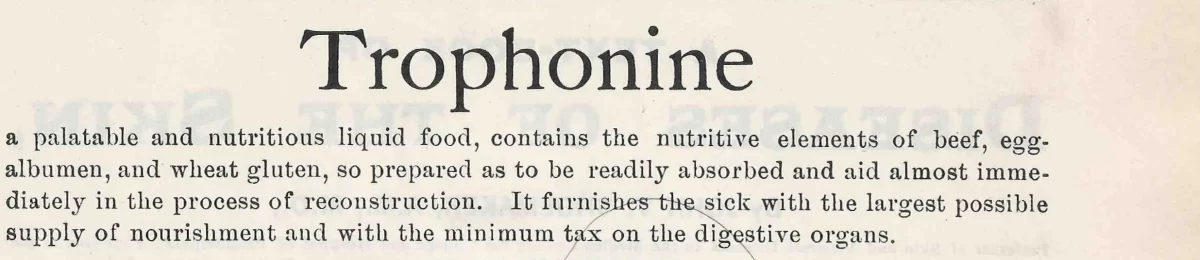
Description
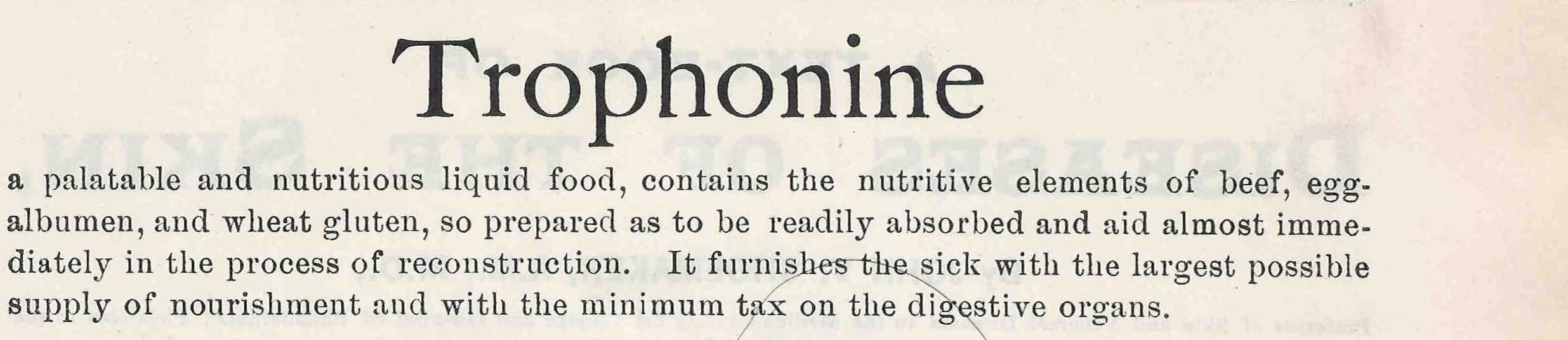
This advertisement snippet promotes Trophonine, described as “a palatable and nutritious liquid food” containing the nutritive elements of beef, egg albumen, and wheat gluten, prepared for easy absorption and rapid nourishment. The copy emphasizes its value in aiding the sick and convalescent with “the largest possible supply of nourishment and with the minimum tax on the digestive organs.”
Though only the textual portion of the ad survives, the phrasing and formulation closely mirror other late-19th- to early-20th-century restorative preparations that combined animal protein and grain extract into tonics for weakness, malnutrition, or recovery.
Condition
Partial advertisement text fragment; edges cropped and background toned from age. Typography remains sharp and fully legible.
Gallery
Historical context
Nutritional restoratives such as Trophonine emerged in the same medical landscape that produced Liebig’s Beef, Wine and Iron and Bovril. These formulas reflected a transition from patent medicines to scientifically presented “liquid foods” marketed to physicians and invalids alike.
Unlike alcohol-based tonics, Trophonine was explicitly promoted as non-alcoholic and easily digestible, positioning it as a modern, wholesome alternative for patients or children unable to tolerate stimulants. It demonstrates the late-Victorian shift toward laboratory nutrition and the medicalization of diet.
Curious Facts, Ephemera, and Trivia
The name “Trophonine” derives from the Greek trophē, meaning nourishment.
Ads for similar products appeared in medical journals and pharmacists’ circulars between the 1890s and 1910s.
Such “liquid foods” often blurred the boundary between dietary supplement and medicine, foreshadowing the rise of 20th-century nutritional science.
Excerpt
“It furnishes the sick with the largest possible supply of nourishment and with the minimum tax on the digestive organs.” — from the advertisement
Why it is in the Cabinet
This surviving advertisement captures the evolving medical concept of nourishment as therapy. Trophonine exemplifies the era’s movement away from intoxicating tonics toward nutritional formulations grounded in physiology, bridging patent medicine and early dietetics.
Support Dr. Bebout’s Cabinet of Medical Curiosities
If you enjoy the history, the oddities, and the effort, help keep this cabinet open. Every little bit helps preserve and share the strange wonders of medicine's past.
Buy Me a Ko-fi ☕ Buy Me a Coffee ☕ Tip via PayPal 💵