
Title
Hunt’s Remedy Sailor Trade Card (1883)
Author
Hunt’s Remedy Co., Providence, Rhode Island
Printed by The Major & Knapp Lith. Co., New York
Image
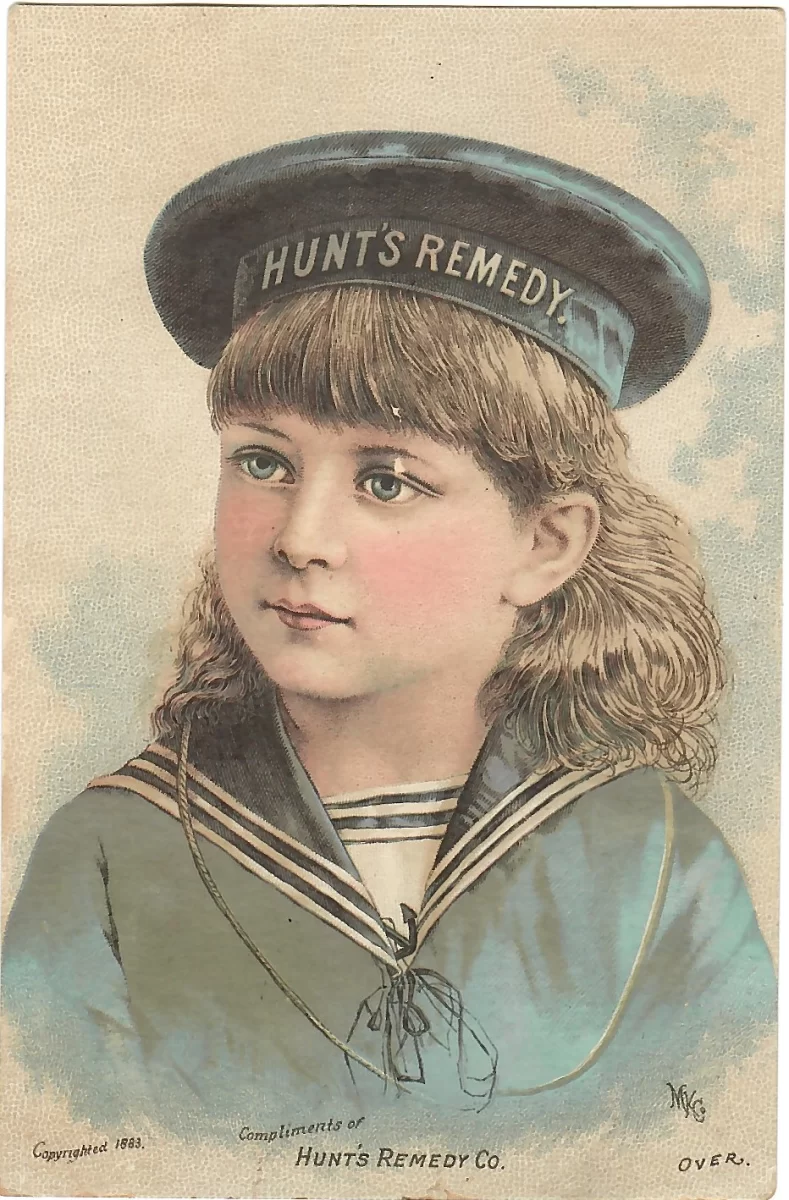
Description
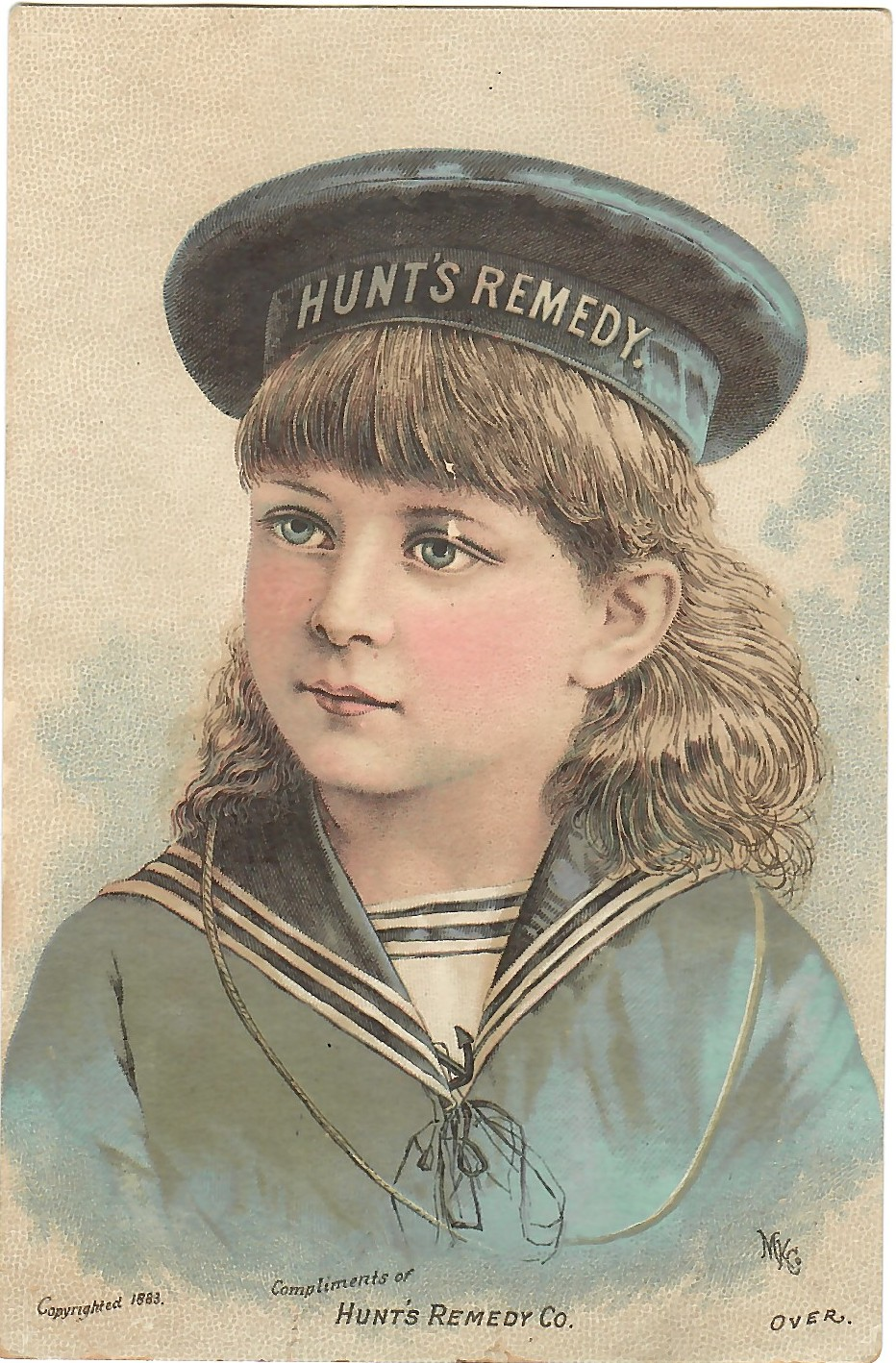
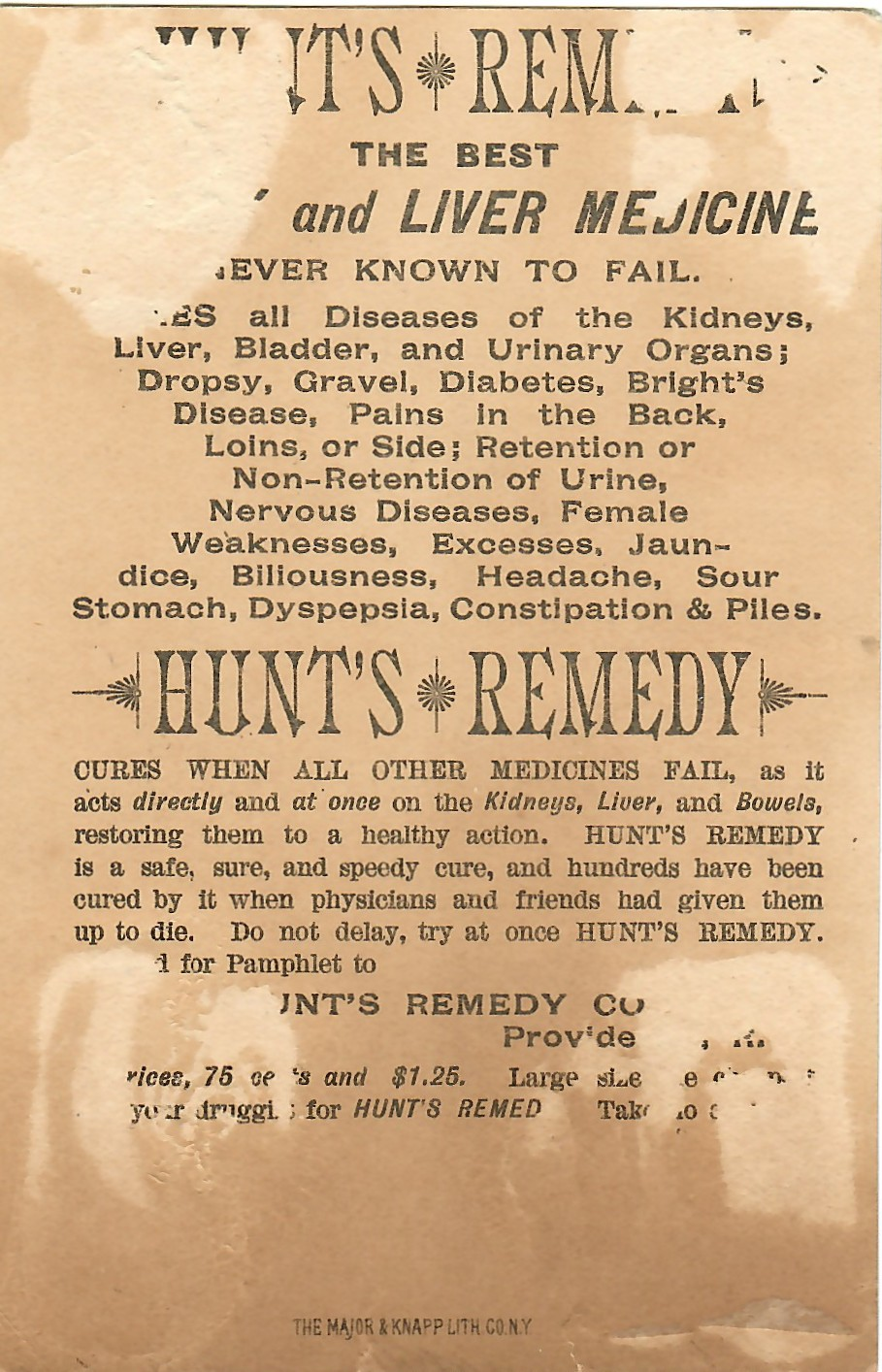
This Victorian chromolithographed advertising card for Hunt’s Remedy depicts a child in a blue sailor suit and cap bearing the product name. The reverse claims that Hunt’s Remedy is “the best Kidney and Liver medicine ever known to fail,” promoting it as a cure for diseases of the kidneys, liver, bladder, and urinary organs, as well as diabetes, Bright’s disease, dyspepsia, and constipation. Bottle sizes are listed at 75¢ and $1.25. The card is copyright 1883 and credits The Major & Knapp Lithographic Company of New York.
Condition
Good overall for age. The front retains vivid color with minor surface wear and softly rounded corners. Reverse side shows age toning, light staining, and small abrasions at the upper and lower margins that obscure portions of the printed text. No restoration or repairs noted.
Gallery
Historical context
Trade cards were a leading form of late-19th-century pharmaceutical advertising, distributed by druggists and patent-medicine companies as promotional keepsakes. Hunt’s Remedy was one of many popular “cure-all” preparations sold during an era of minimal medical regulation. The use of a sailor-suited child mirrored a fashionable Victorian motif that suggested purity, health, and trustworthiness—helping to market potent, often narcotic or alcohol-based tonics to the general public.
The card’s 1883 copyright places it in the high period of the patent-medicine industry, more than twenty years before the 1906 Pure Food and Drug Act, which finally began restricting such exaggerated therapeutic claims.
Curious Facts, Ephemera, and Trivia
Lithographed by Major & Knapp, one of New York’s foremost chromolithographic houses noted for vibrant, detailed printing.
The text promised that Hunt’s Remedy acted “at once on the Kidneys, Liver, and Bowels,” a classic hallmark of the 19th-century “cure-all.”
Dual pricing (75¢ and $1.25) reflected the standard marketing technique of offering small and large bottles to encourage repeat purchases.
Surviving examples like this one are valued for their detailed lithography and early pharmaceutical typography.
Excerpt
“Cures when all other medicines fail… restoring them to a healthy action.”
Why it is in the Cabinet
This trade card exemplifies the intersection of art, advertising, and medicine in the Victorian patent-medicine era. The sailor imagery, fine lithography, and sweeping health claims represent the inventive yet unregulated spirit of 19th-century marketing. It stands as a vivid reminder of how trust, aesthetics, and persuasion once combined to sell hope in a bottle.
Support Dr. Bebout’s Cabinet of Medical Curiosities
If you enjoy the history, the oddities, and the effort, help keep this cabinet open. Every little bit helps preserve and share the strange wonders of medicine's past.
Buy Me a Ko-fi ☕ Buy Me a Coffee ☕ Tip via PayPal 💵