
Title
Blaud Compound B C (Soft) Pills No. 981
Author
Parke, Davis & Co. — Detroit, Michigan
Image
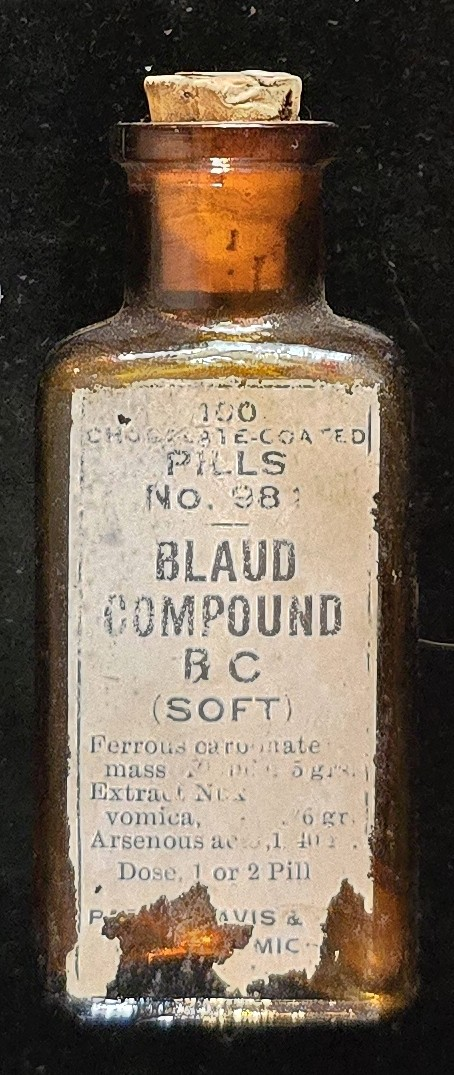
Description
An amber glass bottle containing 100 chocolate-coated pills, labeled Blaud Compound B C (Soft), No. 981. Manufactured by Parke, Davis & Co., one of the earliest and most prominent American pharmaceutical firms.
The label lists the formula:
Ferrous carbonate mass (Blaud’s mass) 5 gr., Extract Nux Vomica 1/6 gr., Arsenous acid 1/40 gr.
Dose: 1 or 2 pills.
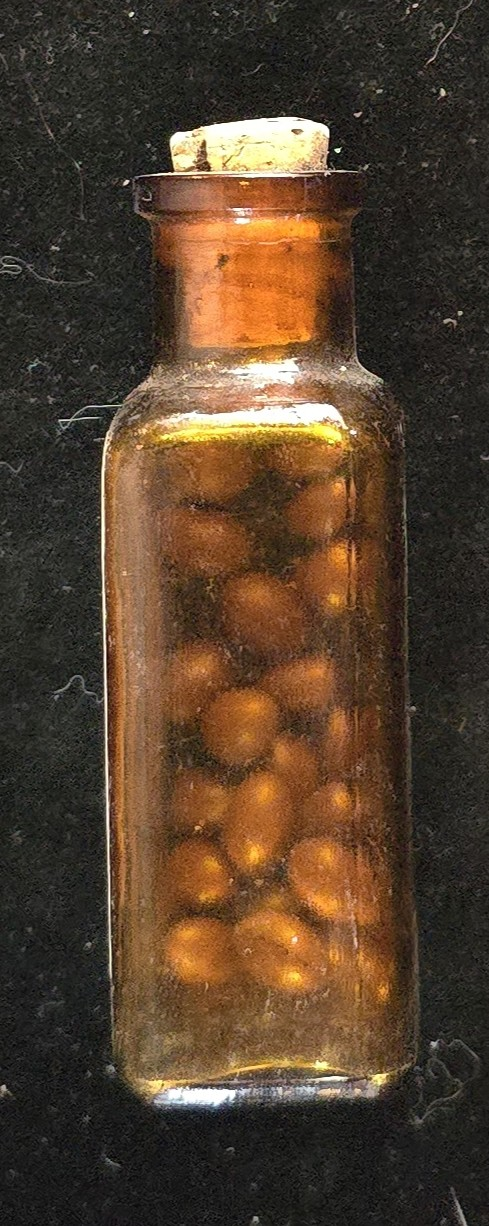
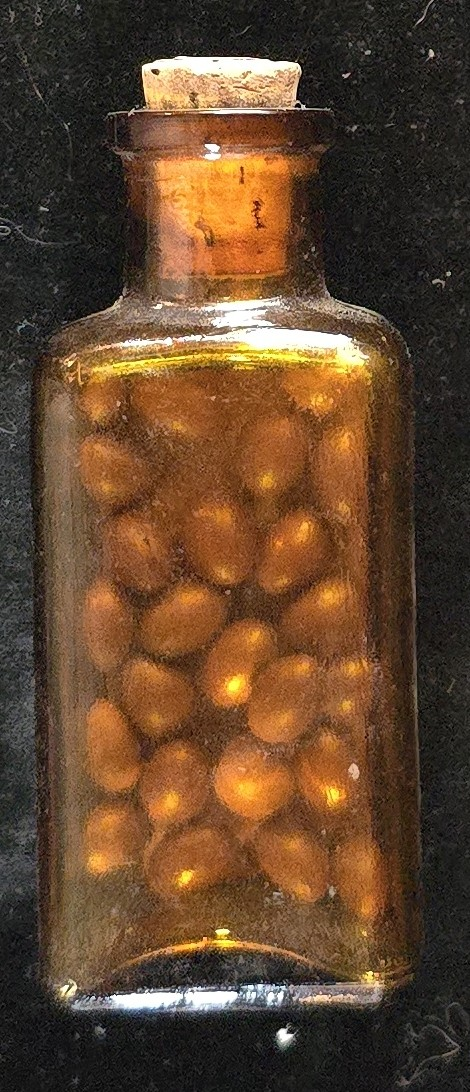
The cork remains intact, and the bottle is still filled with the original coated pills — a rare survival of a once-common iron tonic containing both arsenic and strychnine (from nux vomica).
Condition
Very good condition for age. Label shows edge wear and some paper loss, but text remains legible. Cork stopper intact; contents appear stable and uniformly colored.
Gallery
Historical context
Blaud’s pills were first introduced in the 1830s by French physician Pierre Blaud, who advocated the use of ferrous carbonate for treating anemia.
By the late 19th and early 20th centuries, pharmaceutical companies like Parke, Davis mass-produced the compound in combination with stimulants such as nux vomica (a source of strychnine) and minute doses of arsenic, marketed as blood tonics and general restoratives.
They were prescribed for “weak blood,” fatigue, and menstrual disorders, and were considered essential tonics in early 20th-century medicine before the hazards of arsenic and strychnine were fully recognized.
Curious Facts, Ephemera, and Trivia
“Chocolate-coated” was both a marketing feature and a practical way to mask the metallic taste of iron and bitterness of nux vomica.
Arsenic was frequently used in tonics to “stimulate appetite and vitality” — a belief now known to be dangerously misguided.
Parke, Davis & Co. later became part of Warner-Lambert, which was eventually absorbed by Pfizer, linking this small bottle to a major pharmaceutical lineage.
Excerpt
“Dose, 1 or 2 pills.”
A deceptively simple instruction for a medicine containing two poisons and a heavy metal — a perfect snapshot of the 19th-century balance between therapy and toxicity.
Why it is in the Cabinet
This bottle embodies the fascinating — and perilous — transition between traditional tonics and modern pharmacology. Its mix of iron, strychnine, and arsenic reflects an era when stimulating the body was equated with restoring health, no matter the long-term consequences.
Support Dr. Bebout’s Cabinet of Medical Curiosities
If you enjoy the history, the oddities, and the effort, help keep this cabinet open. Every little bit helps preserve and share the strange wonders of medicine's past.
Buy Me a Ko-fi ☕ Buy Me a Coffee ☕ Tip via PayPal 💵